

Puerto Rico entered August 2026 under a rationing plan that its own water utility called a last resort. Following the driest July on record for San Juan, Governor Jenniffer González-Colón (NPP, R) activated the National Guard and issued a pair of executive orders, OE-2026-35 and OE-2026-36, declaring a state of emergency across the archipelago. Under the plan, roughly 183,000 accounts and the households connected to them began cycling through days with no water at all as reservoir levels fell toward critical thresholds.
The declaration followed a rupture inside the agency responsible for carrying it out. The chairman of the water utility’s governing board, Héctor del Río Jiménez, resigned this month, saying the rationing schedule was decided without ever being brought to the board he led. González-Colón disputed that account publicly, saying the drought measures had been discussed with the board on multiple occasions. Whichever version holds up, the resignation exposed how much confusion, and how little coordination, sits behind a crisis that residents are living through in real time.
Treating the current drought as the whole story understates what has actually gone wrong. Puerto Rico’s water problems predate this drought by years, in some neighborhoods by decades.
A system that was already failing
Long before reservoir levels became a headline, Puerto Rico’s water system was already failing on its own terms. San Juan-area communities logged 118 days of repeated outages this year before rationing even began, and the city’s mayor, Miguel Romero (NPP, D), sued the utility in May over water losses that had nothing to do with the drought. Puerto Rico rationed water before, in 2015 and again in 2020, and a 2016 assessment from the Natural Resources Defense Council found San Juan the worst-performing big-city water system in the United States, years before Hurricane Maria caused any damage at all.
Some of that failure is arithmetic. The territorial government acknowledged that more than half of all treated water never reaches a tap, lost to leaks, aging meters, and unauthorized use before it arrives anywhere. That loss rate means every well or treatment upgrade delivers less relief than the raw numbers suggest, since much of what gets pumped never reaches a household at all. Arif Gasilov, a partner at the environmental consultancy Gasilov Group who has tracked water scarcity in the American West, put the ratio bluntly: “every gallon of reservoir shortage requires two gallons of raw supply.” The American Society of Civil Engineers put the territory’s non-revenue water loss at 59%, more than three times the United States average, and estimated Puerto Rico needs between $1.3 billion and $2.3 billion a year to bring its water infrastructure up to standard.
Some of the failure is structural. Puerto Rico’s water utility controlled only eight of the territory’s 36 reservoirs. Two of its largest, Dos Bocas and Guayabal, had lost 70% and 50% of their original capacity to decades of sediment buildup that was never dredged. Much of the core distribution network dates to the 1940s and 1950s.
Debt, cuts, and a federal board
Some of the failure is financial, and this is where the story stops being only about pipes. Puerto Rico’s water utility answers, in part, to the Financial Oversight and Management Board for Puerto Rico, created under a 2016 law known as PROMESA, and established after years of debt accumulation forced the territorial government into the largest public bankruptcy filing in United States history. Local legislators and a citizen debt-audit commission accused the board of prioritizing bondholder repayment over infrastructure spending, pointing to a newly certified cut of $30 million from the utility’s capital improvement fund, made even as the current crisis unfolded. Separately, of more than $5.1 billion in federal funds assigned to the utility for reconstruction after Hurricane Maria, only about $196 million had actually been disbursed years later, according to an investigation from the Center for Investigative Journalism.
Some of the failure is outright dysfunction. In 2025, the water utility pleaded guilty to 15 felony violations of the Clean Water Act and paid a $9 million fine, the largest ever levied against a utility under that law. Puerto Rico’s resident commissioner in Congress, Pablo Hernandez Rivera (PDP, P), documented what his office called a pattern of institutional failures at an agency serving 97% of the territory’s population. A comptroller’s investigation separately found that the utility’s own executive president had occupied her post illegally for four years.
And running under all of it is Hurricane Maria, which in 2017 devastated a system that outside researchers say was already financially weakened by Puerto Rico’s fiscal crisis dating back to 2006. Hurricane Fiona, five years later, cut water to more than 837,000 customers, roughly two-thirds of the territory, when flooding overwhelmed treatment plants and knocked out the power those plants depend on. Puerto Rico has spent most of the past decade recovering from one disaster only to be hit by the next.
A regional drought, a territorial water crisis
The United States Virgin Islands, Puerto Rico’s neighboring territory, is living through the same drought. Nearly the entire United States Virgin Islands has been under an extreme drought designation since July, and its water authority has reported that residents with low or depleted cisterns are leaning harder than usual on a public system built mostly as backup, since most of the United States Virgin Islands relies on private rooftop cisterns rather than a centralized network. It is a reminder that this drought is a regional climate event, not a uniquely Puerto Rican failure, even where the infrastructure problems it is exposing are specific to each territory.
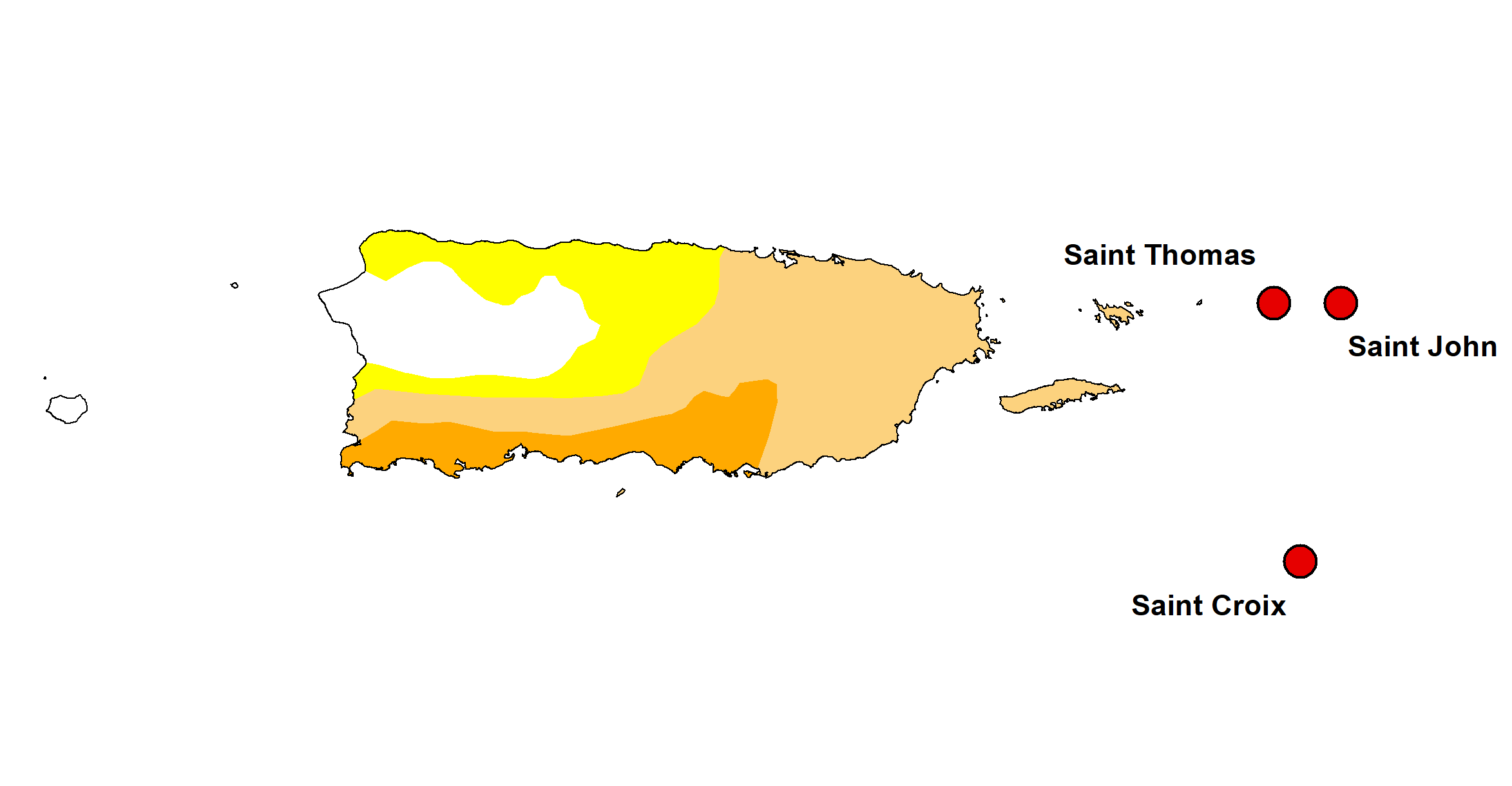
In Puerto Rico, some fixes are already moving, slowly. Legislators introduced a package this year aimed at funding a ten-year dredging plan for the territory’s sediment-choked reservoirs. But the pattern above–chronic underfunding, a debt-driven oversight structure with the power to cut capital spending, and federal recovery money that arrives years late–suggests reservoir levels alone were never the real constraint. Puerto Rico is a United States territory, not a state, and decisions over how its water utility is funded and governed run through federal statute in ways no state government answers to. Any account of this crisis that leaves that fact out is missing the mechanism, not just the details.


0 Comments