

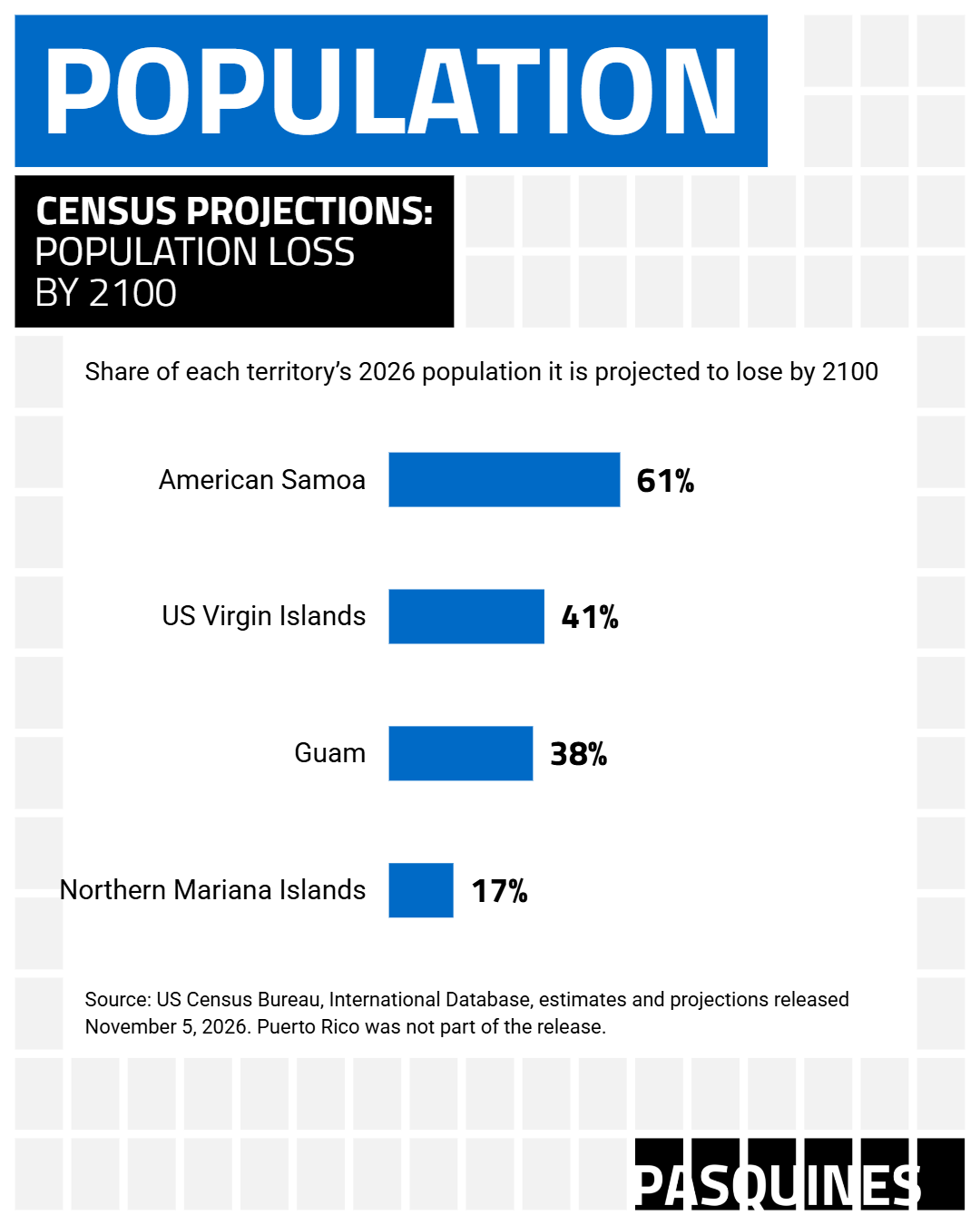
The United States Census Bureau projects that the four US territories in its latest update will all shrink by the end of the century. American Samoa is projected to lose 61% of its 2026 population by 2100, the US Virgin Islands 41%, Guam 38%, and the Northern Mariana Islands 17%, according to estimates and projections the bureau released on November 5, 2026.
- American Samoa61%
- US Virgin Islands41%
- Guam38%
- Northern Mariana Islands17%
Source: US Census Bureau, International Database, estimates and projections released November 5, 2026. Puerto Rico was not part of the release.
Bureau statisticians Sophia Magalona and Rachel J. Bacon wrote that the declines are “driven by a combination of falling fertility and persistent outmigration.” More people have left than moved into each of the territories since 2000, they wrote. The release was the first since 2017 to update the four territories in the bureau’s International Database, and it did not include Puerto Rico.
In absolute numbers, the US Virgin Islands’ projected population of 83,896 in 2026 would fall to 49,331 by 2100. American Samoa’s population was estimated at 41,190 in mid-2026.
A global slowdown, sharpened by departures
Falling birth rates are not unique to the territories. The global fertility rate is 2.3 births per woman, down from 3.3 in 1990, and more than half of all countries and areas have fertility below 2.1, the level needed for a stable population without migration, according to the United Nations’ World Population Prospects 2024. In 63 countries and areas, holding 28% of the world’s people, the population had already peaked before 2024. The UN projects the world’s population will peak at around 10.3 billion in the mid-2080s, and that by the late 2070s people 65 and older will outnumber children under 18.
The United States is on the same path. US population growth slowed in 2025 and is expected to decline eventually, the Census Bureau wrote. The national fertility rate is 1.6, according to the Pew Research Center.
What sets the territories apart is migration. The UN found that immigration is expected to soften population decline in 50 countries, while in the 14 countries and areas with ultra-low fertility, emigration is likely to add to it. The territories have had the opposite: since 2000, more people have left each of them than have moved in.
Puerto Rico, which was not part of the release, has lower fertility than any of the four. Its fertility rate fell from 1.9 in 2005 to 1.0 in 2024, and the median age of Puerto Ricans living on the islands is 45.0, Pew found. The Puerto Rico Institute of Statistics estimated the islands’ population at 3,184,835 as of July 1, 2025, about 97,000 fewer people than in 2020. Between 2024 and 2025, Puerto Rico recorded about 17,950 births and 32,857 deaths.
Fewer births and older islands
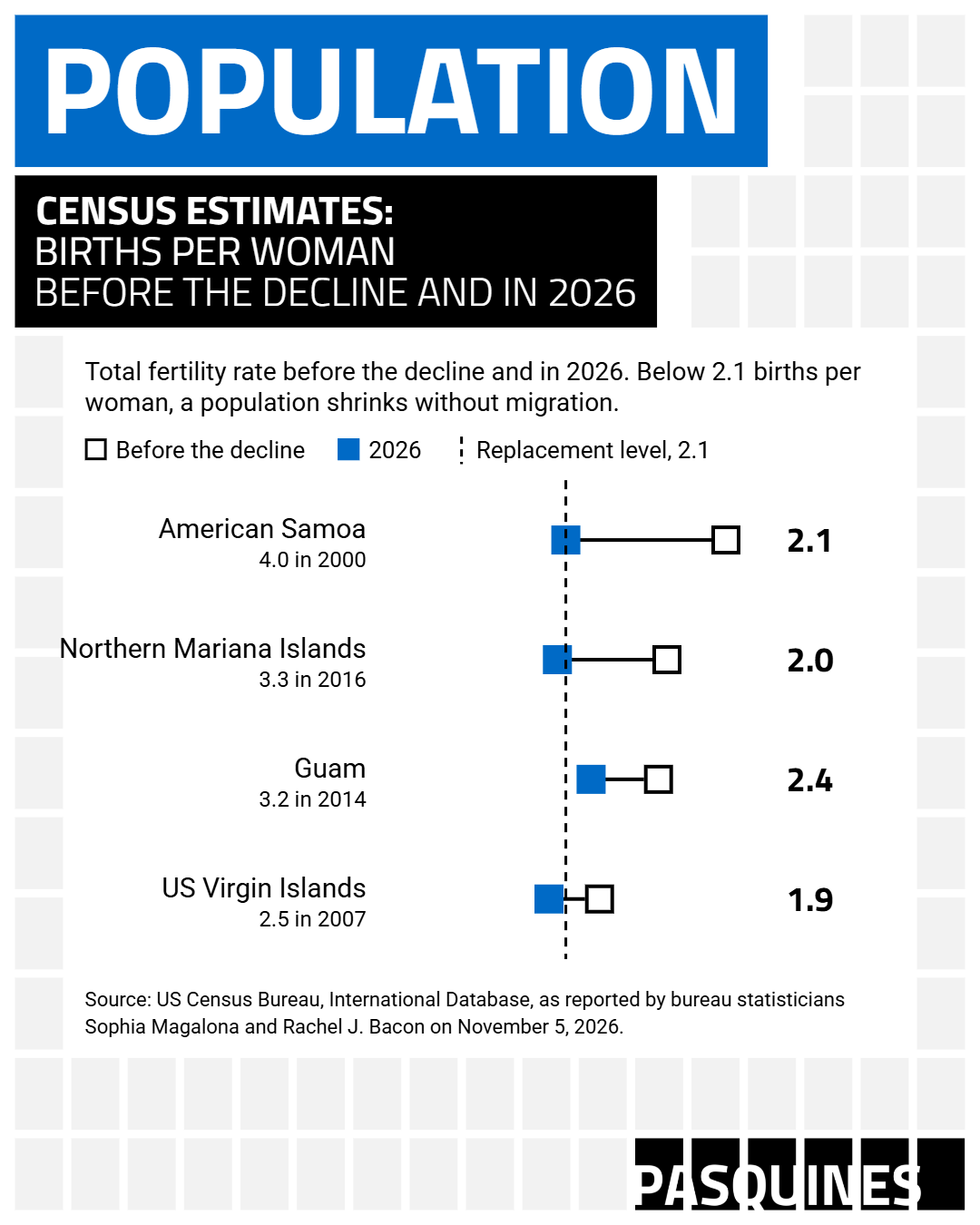
Fertility fell in all four territories over the past decade, the bureau found, with the steepest drops in American Samoa and the Northern Mariana Islands. American Samoa’s fertility rate fell from 4.0 children per woman in 2000 to 2.1 in 2026. In the Northern Mariana Islands, it did not begin to decline until 2016 but fell from 3.3 to 2.0 by 2026. Guam’s fell from 3.2 in 2014 to 2.4, and the US Virgin Islands’ from 2.5 in 2007 to 1.9.
The US Virgin Islands and the Northern Mariana Islands are already below the replacement level of 2.1. American Samoa is projected to fall below it in 2029, and Guam in 2056.
Before the decline2026Replacement level, 2.1
- American Samoa4.0 in 20002.1
- Northern Mariana Islands3.3 in 20162.0
- Guam3.2 in 20142.4
- US Virgin Islands2.5 in 20071.9
Source: US Census Bureau, International Database, as reported by bureau statisticians Sophia Magalona and Rachel J. Bacon on November 5, 2026.
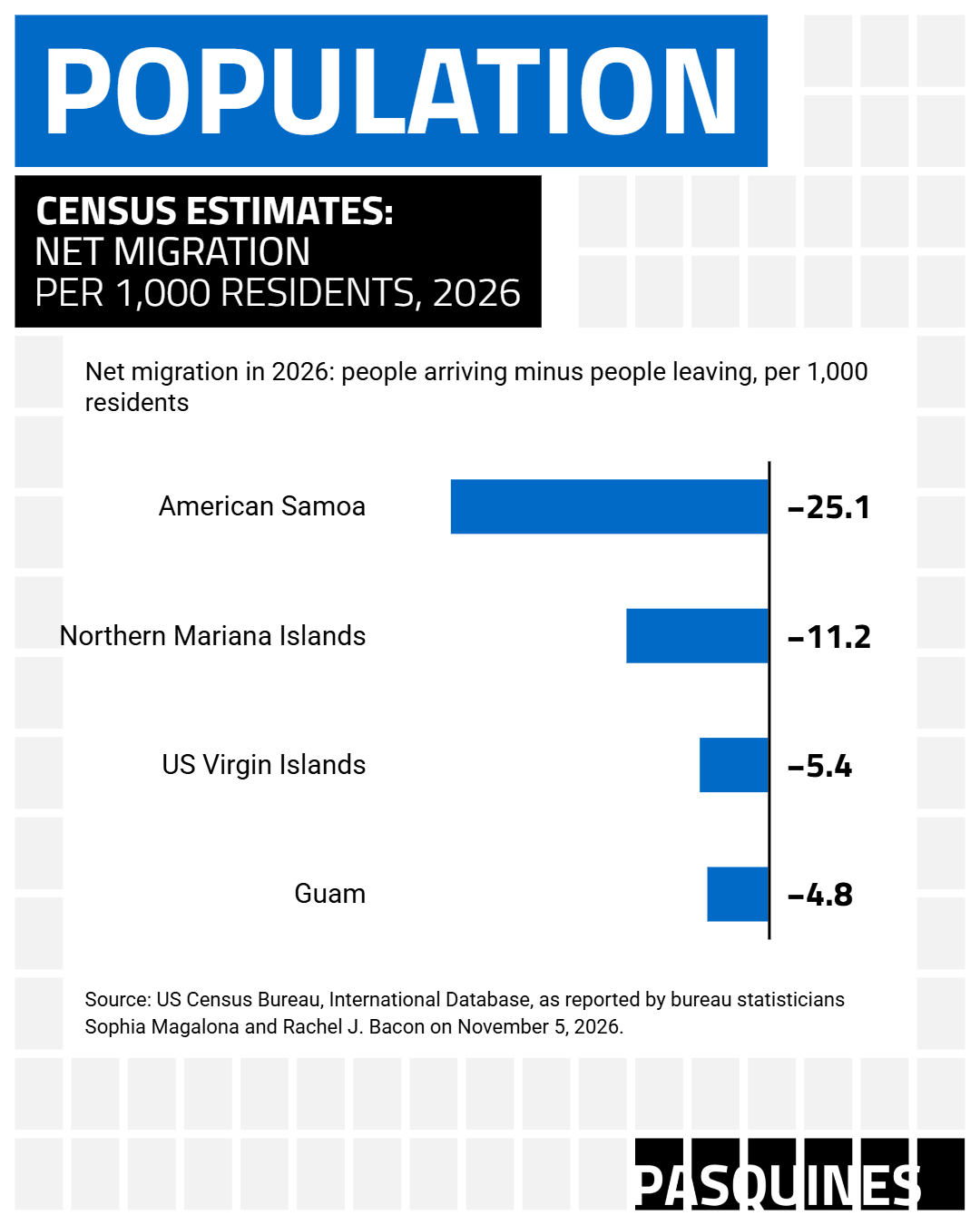
Departures compound the drop. In 2026, net migration, the number of people arriving minus those leaving, was -4.8 per 1,000 residents in Guam, -5.4 in the US Virgin Islands, -11.2 in the Northern Mariana Islands, and -25.1 in American Samoa.
- American Samoa−25.1
- Northern Mariana Islands−11.2
- US Virgin Islands−5.4
- Guam−4.8
Source: US Census Bureau, International Database, as reported by bureau statisticians Sophia Magalona and Rachel J. Bacon on November 5, 2026.
The bureau expects natural decrease, when deaths outnumber births, to begin as early as 2027 in the US Virgin Islands and in 2089 in the Northern Mariana Islands. The US Virgin Islands already has more older residents than children. In 2020, 21.3% of its residents were 65 or older, and 19.6% were under 18, and its median age is projected at 48.5 in 2026, up from 45.9 in 2020, the Virgin Islands Consortium reported.
In Puerto Rico, researchers at Penn State’s Population Research Institute found that the share of adults older than 65 nearly doubled in a decade as more than 700,000 working-age adults left.
The economies behind the departures
Local economies help explain the departures. In the US Virgin Islands, net outmigration jumped between the 2010 and 2020 censuses, which the bureau linked to the shutdown of a large oil refinery, Hurricanes Irma and Maria in 2017, and “persistent economic and structural issues.” In Guam, pandemic travel restrictions meant fewer people left than arrived for a time. Departures have picked up since, but remain below pre-2020 levels.
The Northern Mariana Islands have been through a series of booms and busts, from the collapse of its garment industry to the pandemic’s blow to tourism and the decline of its casino. Its gross domestic product fell from $1.18 billion in 2019 to $858 million in 2024, according to World Bank data cited by the Pacific Island Times. In January, the territory’s leaders, including Delegate Kimberlyn King-Hinds (R), wrote to President Donald Trump (R) and US Indo-Pacific Command urging swift federal action to stabilize the economy. “When core civilian systems begin to fail, the consequences extend well beyond the Commonwealth,” King-Hinds said. On October 30, a suspension by the United States Department of Homeland Security of a visa-free travel program for Chinese visitors took effect.
In American Samoa, which has the highest rate of departures, delegate candidate Tuifagaloa Dr. Afu Lefaoseu III campaigned this year on the territory’s reliance on one industry. He said 83% of its private-sector jobs and 99% of its exports are controlled by one industry, and warned that a territory relying on a single company for its survival is “one global disaster, one trade shift, or one corporate decision away from total economic collapse.”
In Puerto Rico, departures have skewed toward graduates. The New York Federal Reserve found that high school graduates have made up a larger share of those leaving than of the population as a whole since the mid-2000s, and the islands’ labor force participation rate averaged 43.9% in fiscal year 2024, compared with 62.6% on the mainland.
What a smaller, older population could mean
Once deaths exceed births in the US Virgin Islands, the territory would shrink even in a year when as many people arrived as left. As working-age adults leave, fewer people pay taxes while a larger share of residents need health care and other services. In Puerto Rico, researchers have found that older adults left behind face fewer government services, disrupted support networks, and isolation.
The Northern Mariana Islands’ leaders said in their letters that the territory’s fragile economic base leaves it vulnerable to further shocks, with potential effects on infrastructure, workforce stability, and services that support US operations in the region.
Right to Democracy, an advocacy organization that works for democracy and self-determination in the territories, called the projections an indictment of the territories’ relationship with the federal government in a statement on the report. “If these dramatic population declines were predicted for any state, it would be front page national news,” co-director Neil Weare said. “The fact it is not shows how the lack of political power contributes to the invisibilization of our communities.” Co-director Adi Martínez-Román said, “Unilateral federal decision-making does not serve our interests. In order to thrive, our communities need power and agency over the decisions that impact our lives.”
The group has also filed a comment opposing proposed changes to the census, arguing that federal agencies need to improve data collection in the territories and their diaspora, not weaken it. Pasquines has reported on a proposal for the 2030 census that advocates say would erase the “Puerto Rican” checkbox.
What could change the projections
The projections are not destiny. They rest on assumptions, including that net outmigration will decline gradually and reach zero by 2100, the bureau wrote. Migration has already swung quickly. In the Census Bureau’s 2024 estimate, Puerto Rico gained 15,204 more people than it lost to migration, nearly offsetting the gap between births and deaths, before losses resumed in 2025, El Nuevo Día reported. “What will really determine whether the population declines, stays the same, or grows will be migration,” demographer Raúl Figueroa told the newspaper. He also warned that other analyses consider the 2024 gain an overestimate.
Advocates point to the reasons people leave. “No one should have to leave their home and loved ones just to make ends meet or receive the medical care they need,” Weare said.
Other places have tried to win back their emigrants. Portugal’s Programa Regressar, created in 2019, cuts income tax by 50% for returning emigrants’ first five years and helps with moving costs, job creation, and recognition of foreign degrees. More than 36,000 emigrants had used it as of July 2025, the program’s coordinator, José Albano, said. Puerto Rico’s Planning Board published recommendations to curb population loss in 2022, following a multiyear study.
For low fertility, the UN recommends paid parental leave, flexible work arrangements, affordable high-quality childcare, comprehensive care for older people, and a more equal split of caregiving and household work between men and women.
Some efforts are already underway at home. In the Northern Mariana Islands, Northern Marianas College is expanding programs in health care, business, and technology; renewable energy projects have been discussed as a way to lower costs and create local jobs, and remote work could connect workers to global markets without leaving the islands. The territory’s leaders said the federal measures they requested fall within existing federal authorities and would not require new appropriations from Congress.
The Census Bureau periodically updates its International Database as new data become available, and the same release also revised projections for 21 countries, including the United States and Japan.


Be the first to add context