
In the New Progressive Party primary races, the May 2024 edition of the Pasquines Puerto Rico Elections Poll, two candidates have a clear advantage: Pedro Pierluisi (NPP, D) for governor, and William Villafañe (NPP, R) for resident commissioner. In the flash, opt-in poll, conducted from May 22 to May 30, 2024, Pierluisi obtained the support of 63.32% of those surveyed, compared to the 35.10% who supported Jenniffer González-Colón (NPP, R). Similarly, in the race for Puerto Rico’s nonvoting seat in the United States House of Representatives, Villafañe garnered the support of 68.96% of survey respondents, while Elmer Román (NPP, R), garnered the support of 28.47% of respondents.

The poll surveyed 483 respondents who indicated an affiliation with the New Progressive Party and are registered voters in Puerto Rico. The results show a stark contrast to other polls released today, and even to past historical results in primaries of the NPP, which indicates a heavy skew in the sample. Our results were weighted against the 2020 primary, in which Pedro Pierluisi ran against Wanda Vazquez, but even after those calculations, the support for Pierluisi in this poll did reduce significantly in the final results. That said, we should expect the primary to be much closer than these numbers indicate, given the historical tendencies of the party, the relative strength of Jenniffer González-Colón’s candidacy compared to that of Wanda Vazquez’, and the fact that Puerto Rico has not had a governor reelected since 1996.
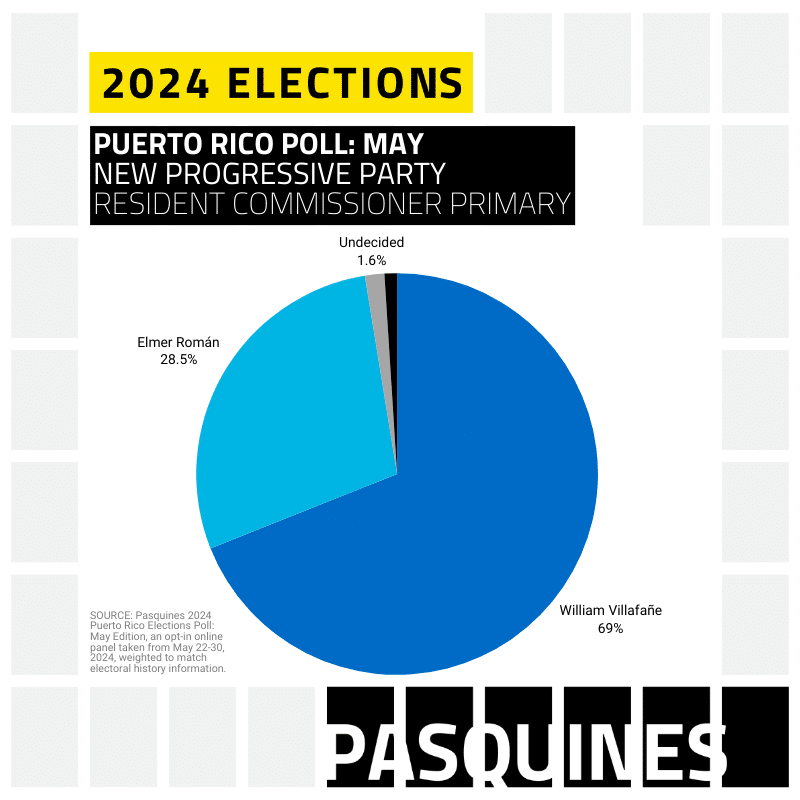
On the resident commissioner race, while we can also expect a closer race, we do have a greater degree of confidence in Villafañe having the lead, comparing to other polls. In addition, Villafañe is a more commonly known name, compared to Román who is making his first foray into electoral politics with this race.
In comparing the two races, it became clear that respondents who supported Pierluisi also mostly supported Villafañe (97.1%). However, a larger proportion of González-Colón’s supporters (21.6%) did not support her selected running mate Román, which could spell trouble for him, even if González-Colón prevails in Sunday’s vote.
Approval ratings
A look at favorability ratings (unweighted, and across all survey respondents regardless of party) might also give an explanation and provide a cautionary tale for how to read these poll results.
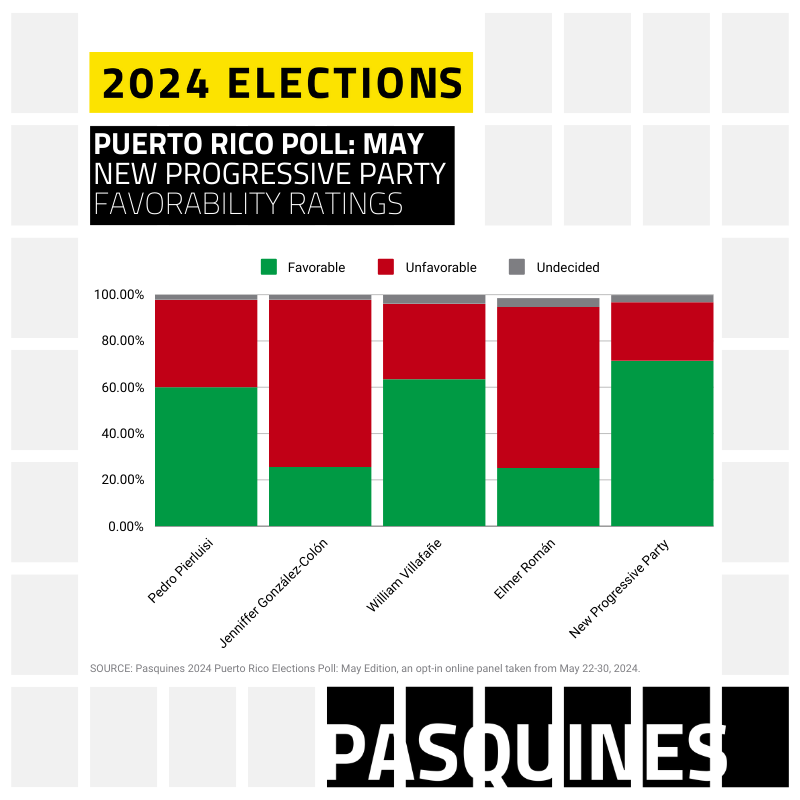
With Pierluisi, Villafañe, and the party itself being the only ones garnering positive overall ratings, our sample clearly was heavily skewed toward supporters of the incumbent governor. That said, this could also be an indicator of discontent within the party’s base given González-Colón’s latest tactics of attacking not just her opponent, but the entire government.
Demographics
In looking at support for the candidates when considering gender, age, and education level, support remained consistent across all groups, likely a result of the sample’s strong favor for Pierluisi, as shown in these unweighted graphs.
Support for NPP gubernatorial candidate by gender
Support for NPP gubernatorial candidate by age group
Support for NPP gubernatorial candidate by education level
https://docs.google.com/spreadsheets/d/e/2PACX-1vRkJ6xDOTi5ENmrco1DNK4TfKjO-sz0HS9KuLqb3eK71JCz5cXhFB2cHpm1LyfOIeAfaG5MUtMvUU4h/pubchart?oid=329380734&format=interactiveWith little more than 48 hours before polls close we will not have to wait long before we can see how accurate our polling this round was. Our previous record has been fairly accurate in predicting winners so we will have to see how close we get to the final result. For this round of polling, we only focused on Puerto Rico and its upcoming primaries. Expect more results tomorrow for the Popular Democratic Party primary, and throughout the week for results involving the approval rating of local and national officials, citizenship questions, and how locals would vote if given a chance in the presidential election.


0 Comments