
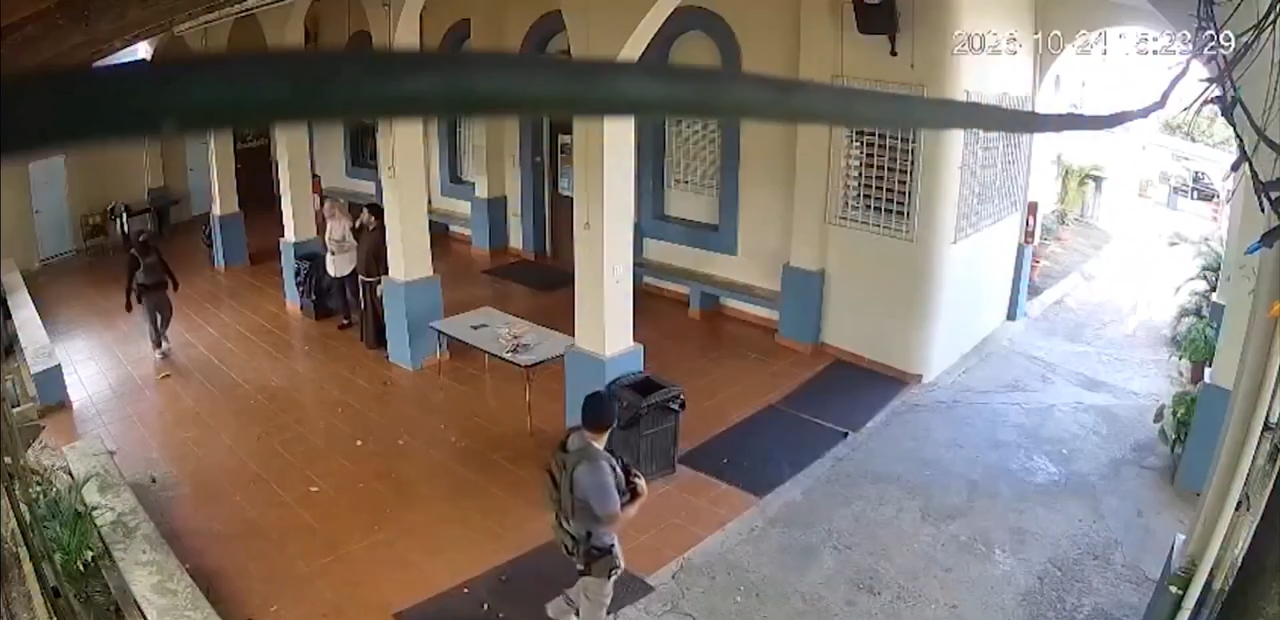
Three armed US Immigration and Customs Enforcement (ICE) agents chasing two immigrants entered the courtyard of the San Antonio de Padua Parish in Río Piedras on October 24, 2026, as about 15 parishioners waited to go to confession, El Nuevo Día reported. The agents carried long guns and demanded to question workers who were repairing the church’s roof. The area they entered is also used by students of the parish’s school, Telemundo Puerto Rico reported.
A parishioner and the parish priest described the scene to El Nuevo Día. “They even searched the bathrooms,” one of them said. Archbishop Eusebio Ramos Morales of San Juan denounced the raid in an October 29 statement, saying that agents reaching the inner grounds of a parish showed they had exceeded their limits. “We say it very clearly: Enough!” he said.
Rebecca González Ramos, director of Homeland Security Investigations (HSI), ICE’s investigative arm, said in November that her commitment not to carry out operations in schools or churches still stood. “Schools, hospitals, and churches are considered ‘sensitive locations.’ We respect that sensitive location,” she said. “If there has been any intervention at a church, a hospital, or a school, it is because there have been individuals who have run toward that periphery.” Governor Jenniffer González-Colón (NPP, R) said ICE operations in churches or schools were unnecessary. “They can wait for the person to leave a church,” she said on November 6.
The raid came 12 days before the Senate of Puerto Rico voted 20 to 4, on November 5, to pass Senate Bill 1062, which would write into law protections for students when ICE agents come to public schools. Before the vote, senators removed provisions that would have barred immigration interventions during class hours and required that a student be kept in a safe place while school officials checked whether an agent’s warrant was legal. The changes drew criticism from senators, civil liberties advocates, and members of the United States Congress, some of whom said the bill now offers less protection than the protocol the Puerto Rico Department of Education already follows.
The bill now goes to the Puerto Rico House of Representatives, where it had its first reading on November 11 and was referred to the House Education Committee. If the House passes it without changes, it will go to González-Colón, El Nuevo Día reported.
Puerto Ricans are US citizens by birth, but Puerto Rico falls under federal immigration law, and ICE has carried out operations on the islands since January 2025. By July 2025, ICE said it had detained 445 people in Puerto Rico, about 72% of them Dominican citizens. The Río Piedras raid came during operations led by ICE’s Enforcement and Removal Operations office in Miami across several San Juan neighborhoods from October 22 to 25, including Barrio Obrero, home to a large share of Puerto Rico’s Dominican community.
A protocol written after schools lost federal protection
On January 20, 2025, Acting United States Secretary of Homeland Security Benjamine Huffman rescinded guidelines that had limited ICE and US Customs and Border Protection enforcement in or near schools, churches, hospitals, and other “sensitive” areas. “Criminals will no longer be able to hide in America’s schools and churches to avoid arrest,” a department spokesperson said.
Days later, as the first large operations reached Puerto Rico, González Ramos, then the HSI special agent in charge in San Juan, said on the radio that agents did not plan to go into schools. “It is not our mission to enter any school, or any elder care site,” she said. Governor González-Colón said she had asked federal officials for a protocol for operations near churches, hospitals, and schools.
Attendance dropped anyway. By the end of January 2025, principals had reported absences of 20% to 60% at some schools with large numbers of foreign-born students, especially from the Dominican Republic, Secretary of Education Eliezer Ramos told WKAQ radio. The department declined to release specific figures, citing the safety of students and staff. “Schools are a sacred place of protection for our children,” Ramos said.
The Department of Education adopted its protocol in February 2025. It was reviewed by César Cedeño, then the Dominican Republic’s consul in Puerto Rico, and by González Ramos, and the Department of Education was the only Puerto Rico government agency that prepared one to protect this population, according to El Nuevo Día. Under the protocol, no minor can be detained without a court order, and the department’s Office of Legal Affairs must certify that an intervention is lawful. Schools cannot share information about a minor’s attendance or location without authorization from a parent, the regional superintendent, or the legal office. No minor can be questioned without a parent or legal guardian present or, failing that, a diplomatic representative of the student’s home country.
What the Senate changed
Senator Nitza Morán Trinidad (NPP) filed the bill on February 6, 2026, as the Educational Equity Law for Immigrant Students. Its statement of motives cites Plyler v. Doe, the 1982 US Supreme Court decision that states cannot deny free public education to undocumented students, and says the bill was inspired by guidance issued by New York State. “What we are seeking with this bill is to give those protections the force of law,” Morán said.
Most of the bill deals with enrollment and bullying. It would guarantee free public schooling regardless of immigration status, bar schools from asking for Social Security numbers or immigration status at enrollment, ban bullying over immigration status, and let families file complaints with the Department of Education or the Puerto Rico Civil Rights Commission. The Department of Education and the Department of the Family endorsed the committee report.
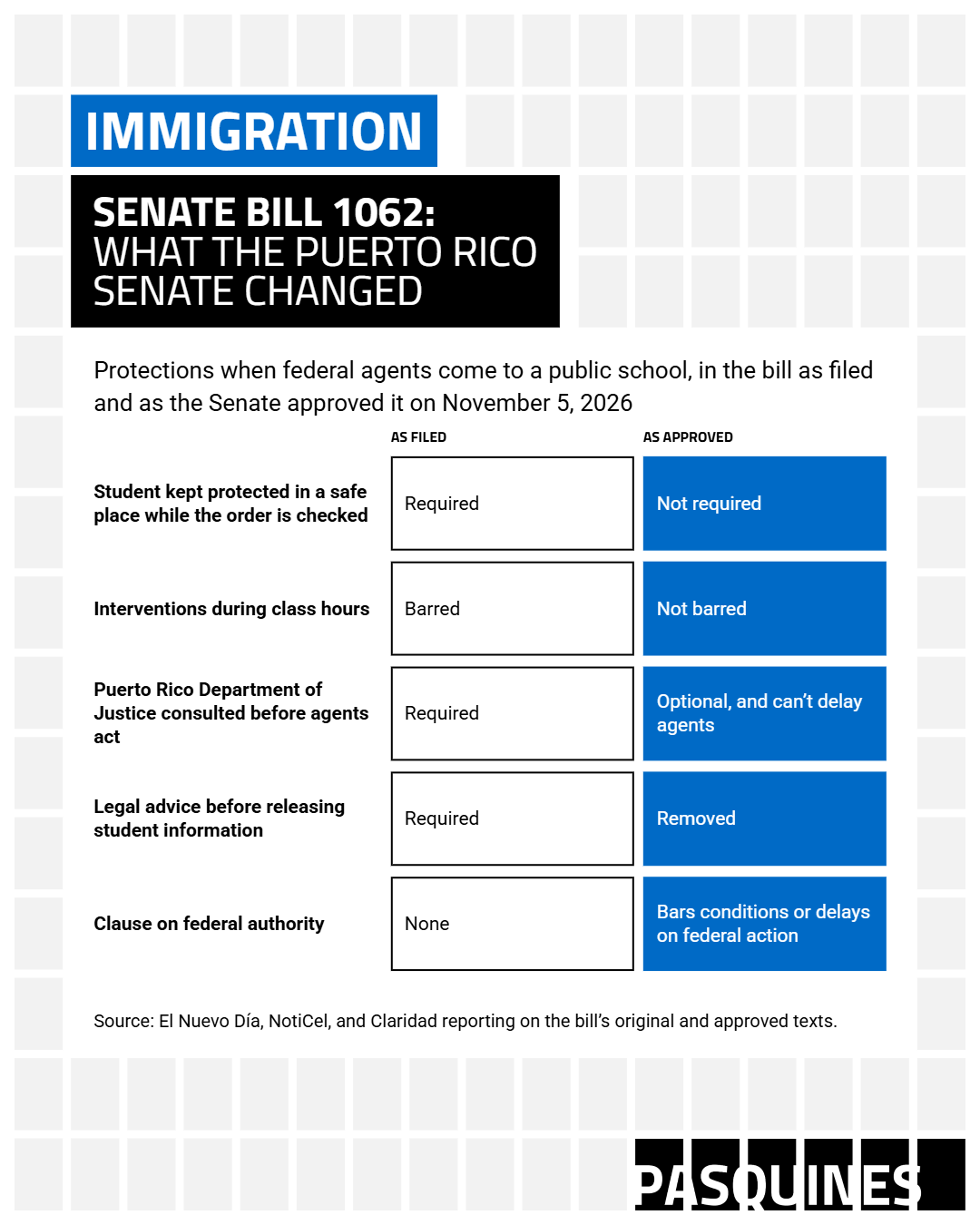
The fight was over Article 7, which governs what happens when agents arrive. The original version required a court order signed by a judge naming the student, and notice to the secretary of education before the order was carried out so the secretary could evaluate the intervention with the Puerto Rico Department of Justice. It gave students a right to have a parent and a lawyer present, required that they be kept “protected in a safe place at the school” while the order was validated, and barred any intervention during class hours.
The Senate Government Committee and the Education, Arts and Culture Committee rewrote that article in a joint report on October 29. The Government Committee held no public hearings, and its changes included language that would have let ICE enter schools with an administrative order issued by the agency itself rather than by a judge, Senator María de Lourdes Santiago Negrón (PIP) told NotiCel. Santiago recalled that ICE used an administrative subpoena in January 2025 to obtain the data of more than 6,000 immigrants who held Puerto Rico driver’s licenses.
Morán removed the administrative-order language on the Senate floor after objections from the minority parties. The approved text says an administrative order alone does not authorize school staff to give agents access to nonpublic areas, and it keeps a ban on staff voluntarily letting federal agents in without a court order.
Other changes stayed. The approved text says the Department of Education “may” consult the Department of Justice, and that notice and consultation are not prerequisites for federal action and cannot be used to delay it. Staff must only “seek” to have a parent present, to the extent the law allows. A student stays in a safe, supervised space “when circumstances allow,” and that space cannot be used to hide the student. Principals may ask that agents act outside classrooms, but the text says nothing in it bars legally authorized interventions during school hours. An earlier requirement to consult legal counsel before releasing student information was also removed.
The approved text also adds a clause on federal authority: “Nothing provided here shall have the effect of imposing additional conditions on the exercise of the powers conferred on federal authorities, requiring authorization from officials of the Government of Puerto Rico for the execution of legally authorized federal actions, or preventing, delaying, or obstructing their enforcement.”
- Student kept protected in a safe place while the order is checkedAs filed: RequiredAs approved: Not required
- Interventions during class hoursAs filed: BarredAs approved: Not barred
- Puerto Rico Department of Justice consulted before agents actAs filed: RequiredAs approved: Optional, and can’t delay agents
- Legal advice before releasing student informationAs filed: RequiredAs approved: Removed
- Clause on federal authorityAs filed: NoneAs approved: Bars conditions or delays on federal action
Sources El Nuevo Día
 NotiCel
 ClaridadReporting on the bill’s original and approved texts.
Who voted against it
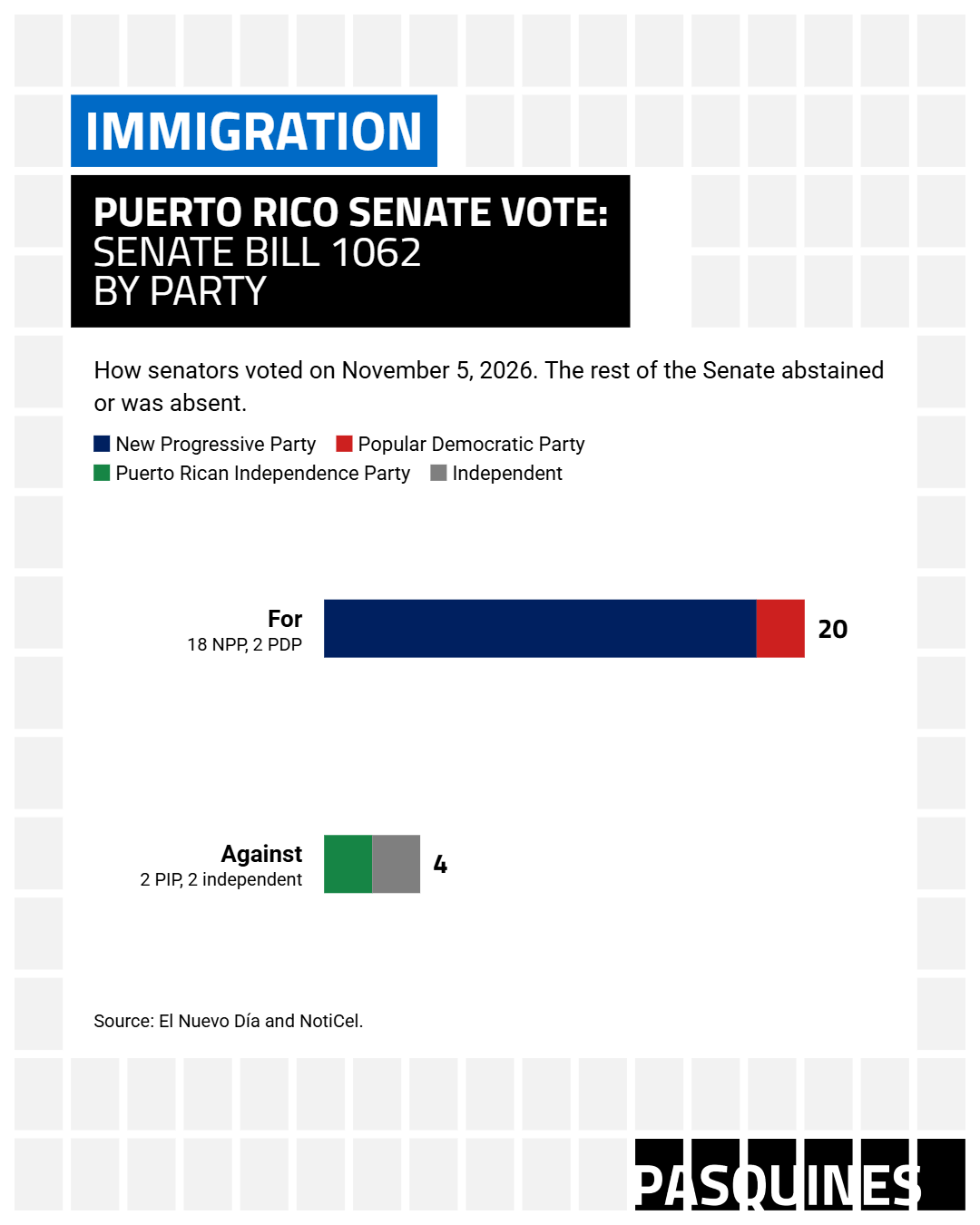
Eighteen senators of the New Progressive Party (NPP) and two of the Popular Democratic Party (PDP) voted for the bill, according to El Nuevo Día. The two senators of the Puerto Rican Independence Party (PIP), Santiago and Adrián González Costa, voted against it, as did independent senators Joanne Rodríguez Veve and Eliezer Molina Pérez. One senator abstained and three were absent, according to the Senate’s vote record.
New Progressive PartyPopular Democratic PartyPuerto Rican Independence PartyIndependent
- For18 NPP, 2 PDP20
- Against2 PIP, 2 independent4
SourcesEl Nuevo DíaNotiCel
“By definition, if you have to call someone or make a consultation, of course that is going to delay the intervention,” Santiago said. “That is the only way to guarantee protection for those girls and boys.”
González Costa, who said he had not opposed the bill before the committee rewrote it, objected to the federal authority clause. “That was not in the original version,” he said. “It is unfair to the secretary of education to say he favors it when he favored the original bill. They created a legal framework contrary to the protections the Department of Education has in place.”
Senator Luis Javier Hernández Ortiz (PDP), his party’s spokesperson in the Senate, was absent for the vote but said he agreed with the original version. “If you ask me, I would not have voted for the bill,” he said. The American Civil Liberties Union of Puerto Rico (ACLU) warned before the vote that the amendments compromised students’ constitutional rights. “No legislation aimed at protecting immigrant children should end up facilitating the very interventions it originally sought to protect them from,” the group said.
Opposition from New York and Washington
The vote drew attention from outside Puerto Rico. On November 6, New York City Mayor Zohran Mamdani (D), who was visiting the islands, said at a news conference that the amendments would let ICE into schools and threaten Puerto Rican children where they should be safest, El Nuevo Día reported. Juan Dalmau, secretary general of the PIP, said NPP and PDP senators had “made common cause to allow the most vulnerable and the most innocent, our children, to be subject to abuse and terror in the place that should be sacred, which is the schools.”
The same day, Representative Nydia Velázquez (D) of New York criticized NPP and PDP senators for backing the bill at a news conference at the Casa Dominicana in Villa Palmeras with Representative Adriano Espaillat (D) of New York and Resident Commissioner Pablo José Hernández Rivera (PDP, D). Velázquez condemned the raid at San Antonio de Padua and said that when the new Congress convenes in January, “ICE abuse is over,” referring to pending bills that would ban masks for immigration agents, require body cameras, and prohibit agents from entering schools or churches, El Nuevo Día reported. Democrats won majorities in both chambers in the November 3 midterm elections.
Hernández Rivera, who is also president of the PDP, said he wanted to see the final text before judging the senators of his party who voted for it, and that he would handle any differences internally. “Zero ICE in schools, in hospitals, in churches,” he said.
Former US Secretary of Education Miguel Cardona, who is Puerto Rican and served under President Joe Biden (D), weighed in on November 10. “For me, it is horrible to see ICE at school to take out children or parents or teachers. For me, it is a crime,” he said after giving the keynote at the annual gathering of Echar Pa’lante, a nonprofit that promotes partnerships among educators. “That keeps parents from trusting schools, and children don’t go to school when that happens.”
What comes next
Opponents of the amendments have pointed to the driver’s license case as a warning. The Puerto Rico Department of Transportation and Public Works gave federal agents the data of 6,321 immigrants after an administrative request from HSI, without a court order, and the ACLU has sued over it. González-Colón defended the handover. “There is a federal subpoena, and Puerto Rico government agencies have to comply with federal mandates,” she said.
It is not yet known whether the House will hold a public hearing on the bill, Claridad reported. In the meantime, the Department of Education’s February 2025 protocol remains in effect.



Be the first to add context