

The United States Department of the Interior held the first offshore critical minerals lease sale in the country’s history on November 19, 2026, auctioning about 31.5 million acres of seabed off American Samoa for $6 million in high bids. The sale came three days after a federal judge in Honolulu threw out the endangered species approval behind it.
On November 16, Judge Jill Otake of the US District Court for the District of Hawaii ruled that the United States National Marine Fisheries Service violated the Endangered Species Act by considering only the preliminary surveys the leases would allow and not the exploration and mining that could follow. She vacated the agency’s Letter of Concurrence, its finding that the sale was not likely to adversely affect protected species, but the order did not include an injunction against the auction.
Earthjustice, the environmental law organization that brought the case, said in a statement sent to Pasquines that the Department of the Interior’s Marine Minerals Administration “ignored the court’s ruling and proceeded with an illegal lease sale.” “In deciding to move forward with today’s scheduled sale, the Trump administration has performed a renegade, unlawful act,” Earthjustice attorney Chris Eaton said. “We will use the full extent of the law to vigorously push for the leases to be voided.”
What was sold
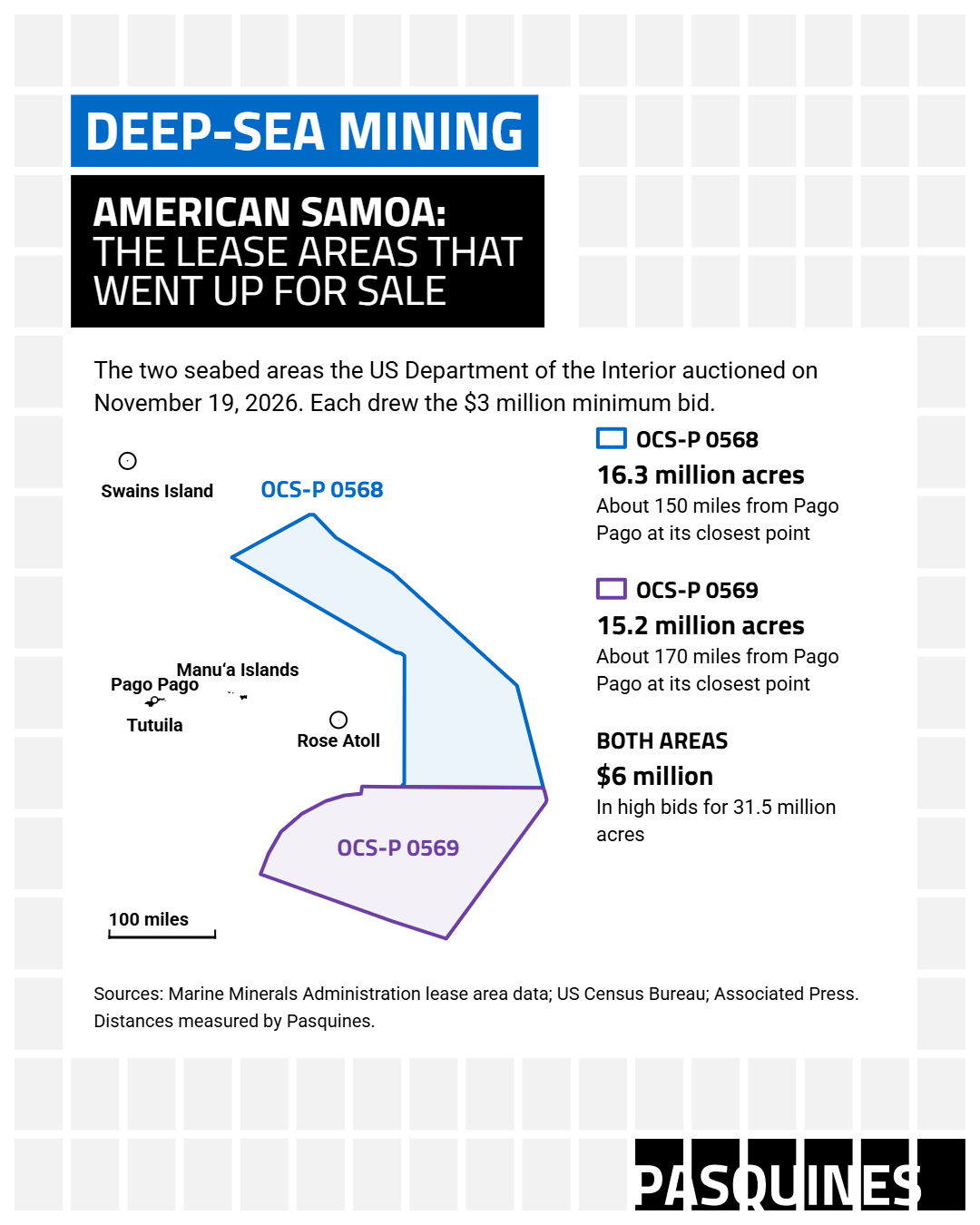
The two lease areas lie 150 to 240 miles east of Pago Pago, in waters 4,630 to 20,100 feet deep, according to the Department of the Interior. The leases carry a 20-year primary term and royalties of 2% for the first five years of production and 5% after that. The minimum bid was $3 million per area, according to the final leasing notice published in October.
Both areas
31.5 million acres
Each area drew the $3 million minimum bid, for $6 million in all. Select an area for details.
OCS-P 0568
16.3 million acres
About 150 miles from Pago Pago at its closest point. Sold for the $3 million minimum bid.
OCS-P 0569
15.2 million acres
About 170 miles from Pago Pago at its closest point. Sold for the $3 million minimum bid.
Both areas
31.5 million acres
Each area drew the $3 million minimum bid, for $6 million in all. Select an area for details.
Sources Marine Minerals Administration
 US Census BureauAssociated Press
The department did not name the winning bidders or mention the court ruling. It said results would be posted online, with a final statistical summary within 90 days, and that the leases do not authorize delineation, testing, or mining, which would require further environmental reviews and approvals. “This is the first time the United States has held an offshore critical minerals lease sale in the Pacific,” Secretary of the Interior Doug Burgum said. Mike Olsen, acting director of the Marine Minerals Administration, said any future development would be subject to rigorous safety and environmental standards.
Wetstone US Ventures, a deep-sea mining startup, won both areas at the $3 million minimum, the Associated Press reported. Two bidders attended the auction, held at the Ventura County Fire Department headquarters in Southern California, but only Wetstone placed bids, while a few dozen protesters gathered outside.
The sale traces to an unsolicited request from Impossible Metals Inc., an American mining company, and to Executive Order 14285 on offshore critical minerals, which President Donald Trump (R) signed in April 2025.
Bidders “on notice”
Before the auction, a Marine Minerals Administration spokesperson told The Hill that the agency “is aware of the opinion.” “We are currently working to address the issues raised in the court’s opinion,” the spokesperson said.
Otake had anticipated the possibility. In a related case, she wrote that if she vacated the review and the administration went ahead with the sale, “any bidders for the leases will be on notice that the Court has determined that NMFS violated the Endangered Species Act,” The Hill reported. Earthjustice attorney David Henkin issued a similar warning, telling The Hill that “if you buy those leases knowing that they haven’t complied with the Endangered Species Act, do not be surprised if the court later sets aside voids, vacates, throws into the garbage can those leases.”
In a statement, the Marine Minerals Administration said it had addressed the court’s opinion by starting to consult with the fisheries service on another environmental assessment, the AP reported. It did not cancel or delay the auction.
A second lawsuit, filed October 19 by Faleula o le Manu‘atele, a council of chiefs from the Manu‘a Islands, along with Fa‘asao Amerika Samoa and the Conservation Council for Hawai‘i, argues that the Outer Continental Shelf Lands Act does not authorize mineral leasing in US territories, including American Samoa.
A territory divided
American Samoa’s leaders have taken different positions. A day before the sale, Governor Pulaali’i Nikolao Pula (R) called it “a historic moment for American Samoa and for our nation.” “Let me be clear: this is not approval to mine our ocean floor,” he said. “American Samoa must not simply be a spectator in decisions affecting our ocean and our future.” His administration is exploring positioning Pago Pago as a regional maritime and logistics hub for deep-sea minerals activity, and he called for federal help to rehabilitate the port.
Delegate Aumua Amata Coleman Radewagen (R) has said her opposition to seabed mining has not changed. “I represent our people, and most of our people are opposed,” she said in July. The Marine Minerals Administration received more than 76,000 public comments on the sale, the overwhelming majority opposed, according to the Natural Resources Defense Council, an environmental advocacy group. “Deep-sea mining is not the future we want for American Samoa,” said Sabrina Suluai-Mahuka, founder of Finafinau, a youth-centered environmental organization in American Samoa. “We had hoped it would never come to this,” Suluai-Mahuka said after the sale, the AP reported.
Ocean Conservancy, an environmental advocacy group, said the seabed went for 20 cents per acre. “From Alaska to American Samoa, the people most affected by these lease sales have long and firmly maintained: ‘not in our waters,’” said ‘Wáahlaal Gíidaak, the group’s vice president of Arctic and Northern Waters.
The Marianas sale is next
The administration plans a second sale on December 16 for seabed off the Northern Mariana Islands and Guam, where the closest lease area lies about 47 miles from Guam. The same lawyers have asked Otake to throw out the National Marine Fisheries Service’s approval for that sale on the same grounds, and Earthjustice attorney Harley Broyles told The Guam Daily Post in October that she anticipated “a similar or like ruling.”
Any leases that are issued could also become harder to undo. Earthjustice has argued that a provision in the Bipartisan American Affordability and Jobs Act, a permitting bill the US Senate advanced on November 16, could lock in such leases by barring future administrations from revoking or altering them except in limited circumstances.
- Lease sales
President Donald Trump signed Executive Order 14285 on offshore critical minerals.
- Courts
Fa‘asao Amerika Samoa and the Conservation Council for Hawai‘i sued the National Marine Fisheries Service.
- Courts
Faleula o le Manu‘atele joined a second lawsuit arguing that federal law does not authorize mineral leasing in US territories.
- Lease sales
The final notice of the American Samoa sale was published, with a minimum bid of $3 million per area.
- Courts
Judge Jill Otake vacated the fisheries service’s Letter of Concurrence but did not block the auction.
- Lease sales
Governor Pulaali’i Nikolao Pula called the sale “a historic moment for American Samoa and for our nation.”
- Lease sales
The Department of the Interior auctioned about 31.5 million acres off American Samoa for $6 million in high bids.
- PlannedLease sales
The Marine Minerals Administration plans the Marianas lease sale.
Sources US Department of the Interior
 Court ruling
 Federal RegisterEarthjustice
 Samoa News
 Pasquines


Be the first to add context