

The Supreme Court of Puerto Rico canceled LUMA Energy’s contract to run the islands’ electric transmission and distribution system on November 25, 2026, ruling 5-4 that a 2022 extension keeping the company in place was invalid, and ordered an orderly transition to a new operator to be completed within one year.
Canceling the LUMA contract was one of the main campaign promises of Governor Jenniffer González-Colón (NPP, R), who joined lawsuits filed by the Puerto Rico Electric Power Authority (PREPA) and the Public-Private Partnerships Authority in December 2025. She has said several American companies are interested in running the system.
What the court decided
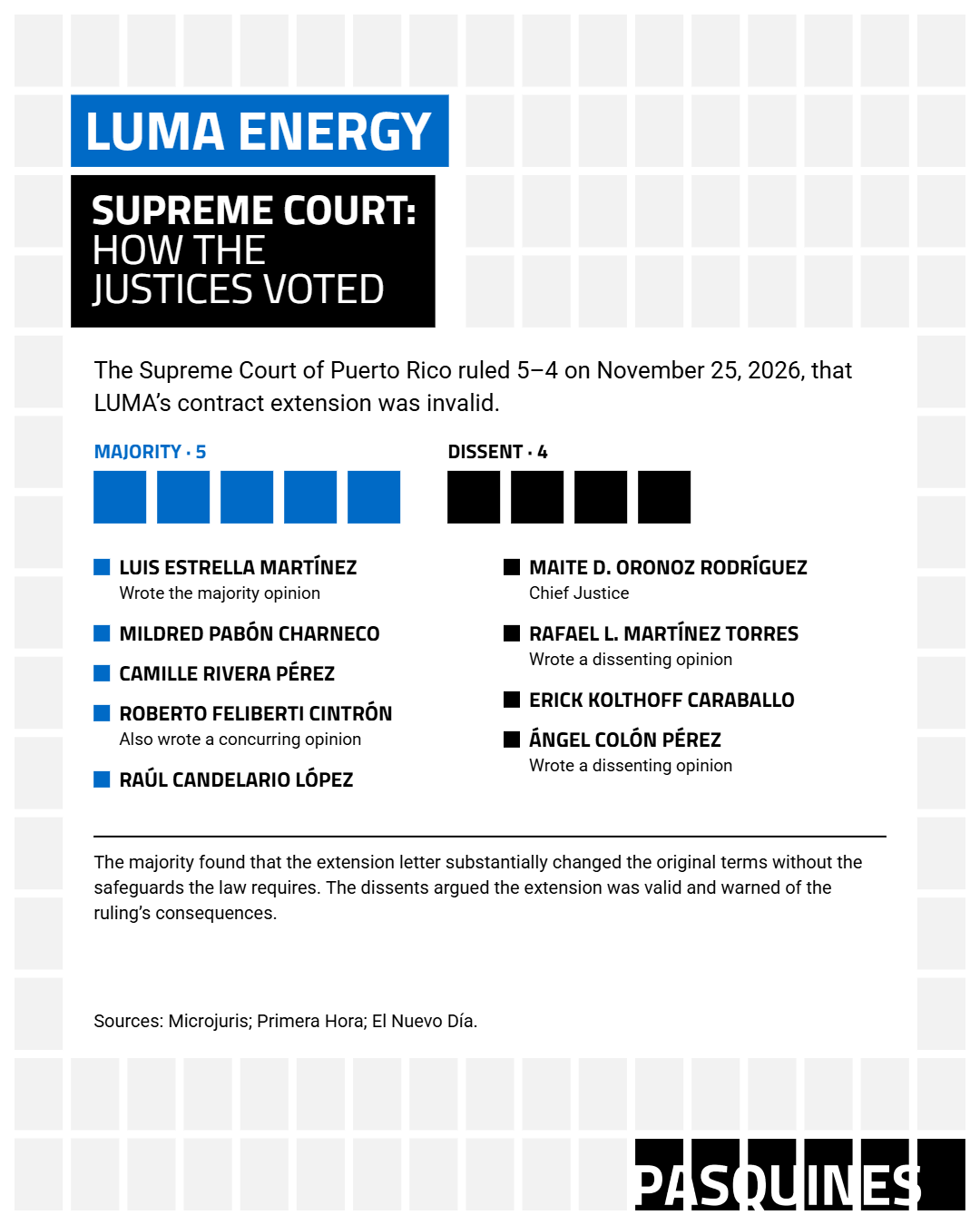
Associate Justice Luis Estrella Martínez wrote the majority opinion, joined by Associate Justices Mildred Pabón Charneco, Camille Rivera Pérez, Roberto Feliberti Cintrón, and Raúl Candelario López. Feliberti Cintrón also wrote a concurring opinion.
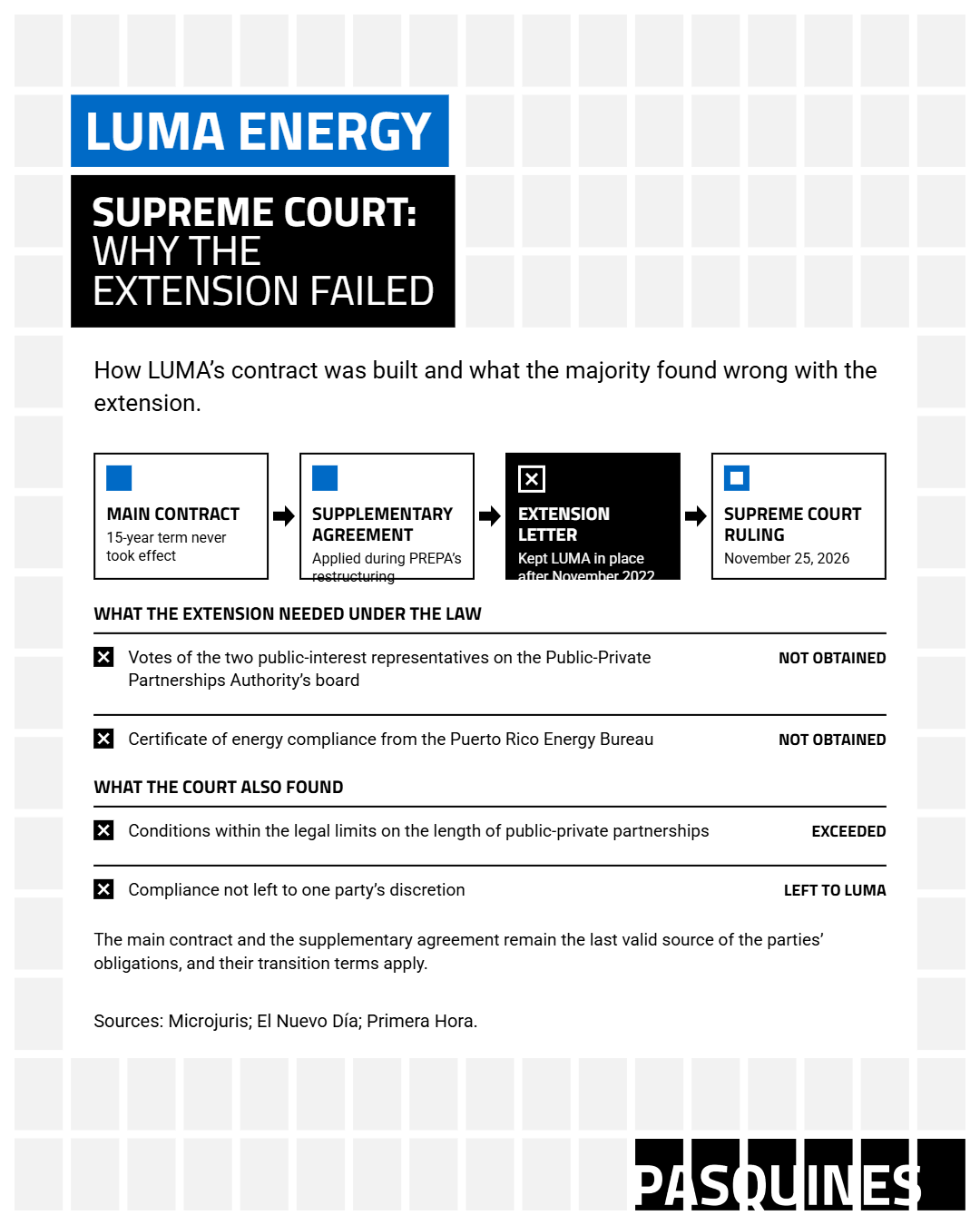
The majority found that a 2022 letter extending the relationship between the government and LUMA substantially changed the originally agreed terms, so it needed the same safeguards as the original deal: the votes of the two public-interest representatives on the Public-Private Partnerships Authority’s board and a certificate of energy compliance from the Puerto Rico Energy Bureau. It had neither. The court also found that the extension’s conditions exceeded legal limits on the length of public-private partnerships and left some compliance entirely to LUMA’s discretion.
Step 1 of 4
Main contract
LUMA’s base contract to operate the transmission and distribution system ran 15 years, but that term never began.
Step 2 of 4
Supplementary agreement
The parties agreed to a supplementary agreement with special conditions, including higher compensation, that applied while PREPA remained in restructuring under PROMESA. It initially ran 18 months.
Step 3 of 4
Extension letter
An extension letter kept the relationship going after November 2022. The majority found it substantially changed the originally agreed terms, so it needed the same approval procedure as the main contract and the supplementary agreement.
Step 4 of 4
The ruling
The court ruled 5–4 that the extension is void. The main contract and the supplementary agreement remain the last valid source of the parties’ obligations, and their transition terms must be fulfilled within one year, under the supervision of the Court of First Instance.
What the extension needed under the law
- Votes of the two public-interest representatives on the Public-Private Partnerships Authority’s boardNot obtained
- Certificate of energy compliance from the Puerto Rico Energy BureauNot obtained
What the court also found
- Conditions within the legal limits on the length of public-private partnershipsExceeded
- Compliance not left to one party’s discretionLeft to LUMA
Under the ruling, the main contract and its supplementary agreement remain the last valid source of the parties’ obligations, and the transition must be completed within the contract’s one-year term, counted from November 25. The Court of First Instance will supervise the process.
Chief Justice Maite D. Oronoz Rodríguez and Associate Justices Rafael L. Martínez Torres, Erick Kolthoff Caraballo, and Ángel Colón Pérez dissented. Martínez Torres argued that the extension was not a new transaction requiring new approval and that assigning supervision to the trial court violates the separation of powers. Colón Pérez warned that the ruling undermines legal certainty.
Majority
Extension void
- Luis Estrella MartínezAssociate Justice · Wrote the majority opinion
- Mildred Pabón CharnecoAssociate Justice
- Camille Rivera PérezAssociate Justice
- Roberto Feliberti CintrónAssociate Justice · Also wrote a concurring opinion
- Raúl Candelario LópezAssociate Justice
The majority’s reasoning
- The extension letter substantially changed the originally agreed terms, so it needed the same safeguards as the original deal.
- It lacked the votes of the two public-interest representatives on the Public-Private Partnerships Authority’s board and a certificate of energy compliance from the Puerto Rico Energy Bureau.
- Its conditions exceeded legal limits on the length of public-private partnerships and left some compliance entirely to LUMA’s discretion.
Dissent
Extension valid
- Maite D. Oronoz RodríguezChief Justice
- Rafael L. Martínez TorresAssociate Justice · Wrote a dissenting opinion
- Erick Kolthoff CaraballoAssociate Justice
- Ángel Colón PérezAssociate Justice · Wrote a dissenting opinion
The dissents
- Martínez Torres argued that the extension was not a new transaction requiring new approval and that assigning supervision of the transition to the trial court violates the separation of powers.
- Colón Pérez warned that the ruling undermines legal certainty, trust in government contracting, and Puerto Rico’s credibility as a place to do business.
What comes next
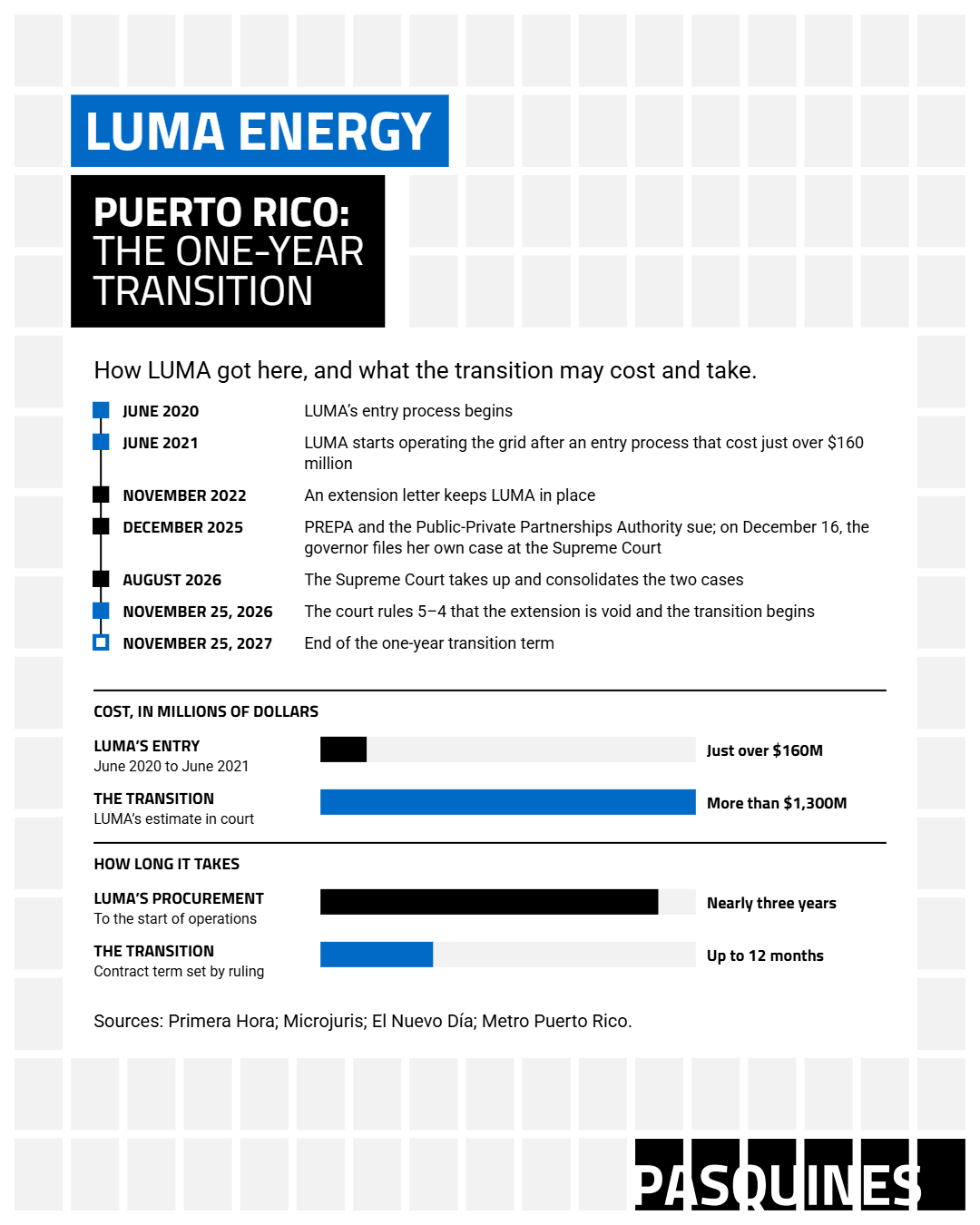
The contract gives the Public-Private Partnerships Authority up to 12 months to select a new operator and oversee the technical and administrative handover. LUMA had argued in court that the transition would cost more than $1.3 billion, including termination payments, a year of continued operation, and other PREPA costs. The procurement that brought LUMA in cost just over $160 million.
The one-year transition term runs from November 25, 2026, to November 25, 2027
In millions of dollars
LUMA’s entryJune 2020 to June 2021
Just over $160M
The transitionLUMA’s estimate in court
More than $1,300M
LUMA’s estimate includes termination payments, a year of continued operation, and other PREPA costs.
How long it takes
LUMA’s procurementFrom the request for qualifications to the start of operations
Nearly three years
The transitionContract term set by the ruling
Up to 12 months
In that time, the Public-Private Partnerships Authority must select a new operator and oversee the technical and administrative handover.
How LUMA got here
- LUMA’s entry process begins
- LUMA starts operating the grid after an entry process that cost just over $160 million
- An extension letter keeps LUMA in place
- PREPA and the Public-Private Partnerships Authority sue to void the extension. On December 16, Governor Jenniffer González-Colón (NPP, R) files her own case at the Supreme Court
- The Supreme Court takes up and consolidates the two cases
- The court rules 5–4 that the extension is void and the one-year transition begins
- One year after the ruling took effect, the end of the transition term
Sources Primera Hora
 Microjuris
 El Nuevo Día
 Metro Puerto Rico · 2025Primera Hora · 2025Metro Puerto Rico · 2026
Before the ruling, LUMA President Janisse Quiñones said the company would not leave the system adrift and would be willing to present the conditions it would need to keep operating it for a defined period.
LUMA, a consortium of Quanta of the United States and ATCO of Canada, has run the grid for about five years, a period marked by criticism of its performance and disputes with PREPA over budget transfers, billing, and federal reimbursements. Its 15-year base contract never took effect, because a supplementary agreement with special conditions and higher compensation applied while PREPA remained in restructuring under PROMESA.
This is a developing story.


Be the first to add context