

The four places that sent the most people into the United States military in 2022, measured against their populations, were not states. Guam ranked first, followed by the Northern Mariana Islands, the US Virgin Islands, and American Samoa, according to a May 2024 report by the United States Government Accountability Office (GAO). The GAO compared US Department of Defense enlistment records with US Census Bureau and World Bank population estimates for the 50 states, DC, the five territories, and three Pacific nations in free association with the US. Guam’s rate was more than double that of the top-ranking state. The Republic of Palau, one of those freely associated states, came fifth.
The same report described what comes after the uniform. Veterans in the territories “must travel long distances for specialty care at VA facilities”; many of them do not qualify for the travel reimbursement offered by the US Department of Veterans Affairs (VA), and the agency “lacks assurance” that its estimates of how many veterans live there are accurate.
Residents of the territories also have limited say over the programs that serve them. Their delegates and Puerto Rico’s resident commissioner in the US House can vote in committee but not on final passage of bills. People born in American Samoa are US nationals rather than citizens, and they can serve in the military.
Every territory has a claim
Territorial leaders have said for years that their islands serve at the highest rates, and the claims overlap.
When Delegate James Moylan (R) of Guam, a veteran, introduced a military family leave bill in May 2025, he described Guam as “the district with the highest level of enlistments per capita.” The GAO data backs him up for 2022. Lieutenant Colonel John A. Guerrero, commander of the Guam Army National Guard, pointed to family in a January 2025 Pacific Island Times report. “Many of our recruits come from families in which there is at least one family member serving,” he said. A CBS News report the same year put it in economic terms: “For people in Guam, military service is an economic opportunity.”
American Samoa makes a similar case. An average of 166 residents enlist in the active-duty Army or the Army Reserve each year, from a population of under 47,000, the Army reported in September 2025, describing the territory as having “one of the highest per capita military enlistment rates.” In 2014, the Army recruiting station in American Samoa ranked first in production among 885 Army recruiting stations and centers worldwide, Samoa News reported. The territory also drew national attention in 2012 for having the highest number of Iraq War casualties per capita of any part of the US, and Samoa News reported that 17 of the more than 4,250 US service members killed in Iraq were from American Samoa.
Delegate Stacey Plaskett (D) of the US Virgin Islands told the US House in a November 9, 2017, speech honoring veterans that the territories send more people per capita into the military than anywhere else in the country. The GAO ranked the US Virgin Islands third in 2022.
The Northern Mariana Islands ranked second, and Guam Army National Guard recruits from the Northern Mariana Islands rose from three in 2022 to 75 in 2024, according to US Indo-Pacific Command figures cited by Pacific Island Times. The Pacific claims are not new. In 2005, The New York Times reported that enlistments from Guam, Saipan, and American Samoa were “the nation’s highest per capita.”
Puerto Rico’s claim is more modest. In a November 13, 2013, floor speech for Veterans Day, then-Resident Commissioner Pedro Pierluisi (NPP, D) quoted former US Attorney General Dick Thornburgh on the US House floor: “Historically, Puerto Rico has ranked alongside the top five States in terms of per capita military service.” Pierluisi also said residents of the islands had deployed about 35,000 times since the September 11 attacks.
Puerto Rico was not in the GAO’s top five for 2022, but its numbers are large. Puerto Ricans became US citizens under the Jones-Shafroth Act on March 2, 1917, and about 236,000 registered for the World War I draft that July. About 61,000 Puerto Ricans served in the Korean War, and more than 750 died there. In April 2016, President Barack Obama (D) awarded the Congressional Gold Medal to the soldiers of the 65th Infantry Regiment.
Pasquines has published versions of these claims as well. A 2018 Pasquines feature said Guam had the highest rate of military enlistment compared with the 50 states, while a 2023 story said American Samoa had enlisted more soldiers per capita than any other territory or state. In 2022, Charles V. Ala’ilima, an American Samoan attorney, said American Samoans have “the highest military enlistment and casualty rates of any US jurisdiction,” and Michelle Mataese, president of the Samoan Federation, said they have “the highest rate of military service of any American community.” A 2023 Pasquines essay noted that American Samoa, Guam, and Puerto Rico “have claimed at different points some of the highest enlistment and service rates across the entire US.”
The GAO did not publish the rates behind its ranking, only the order, and the ranking covers a single year.
How many veterans live there depends on who is counting
High enlistment does not always show up as a large share of veterans at home. The census counts veterans where they live, not where they enlisted.
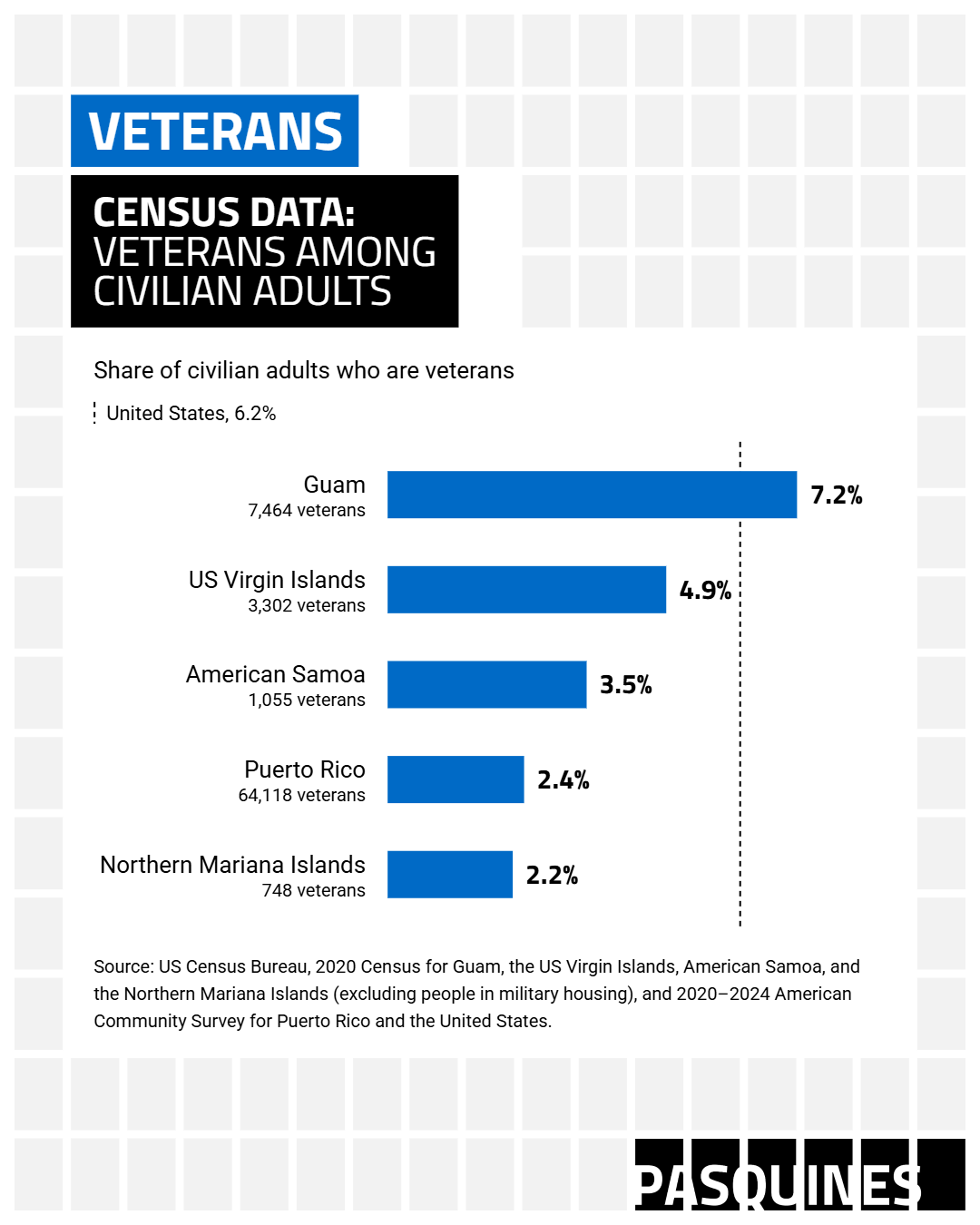
In the 2020 census of Guam, 7,464 civilian adults, or 7.2%, were veterans, a count that excluded people living in military housing. That was above the national rate of 6.2% of civilian adults in the Census Bureau’s American Community Survey for 2020 to 2024, a different survey. The other territories came in lower: 4.9% in the US Virgin Islands, or 3,302 veterans; 3.5% in American Samoa, or 1,055; and 2.2% in the Northern Mariana Islands, or 748. Puerto Rico had the most veterans of any territory, 64,118, but one of the smallest shares, at 2.4% of civilian adults. About two-thirds of Puerto Rican veterans live in the states, Prism reported in 2025.
United States, 6.2%
- Guam7,464 veterans7.2%
- US Virgin Islands3,302 veterans4.9%
- American Samoa1,055 veterans3.5%
- Puerto Rico64,118 veterans2.4%
- Northern Mariana Islands748 veterans2.2%
Source: US Census Bureau, 2020 Census for Guam, the US Virgin Islands, American Samoa, and the Northern Mariana Islands (excluding people in military housing), and 2020–2024 American Community Survey for Puerto Rico and the United States.
The VA’s own estimates differ. Its most recent published population model, VetPop2023, estimated 79,811 veterans in Puerto Rico at the end of fiscal year 2023. It does not break out the other territories, grouping them with veterans abroad under “Island Areas & Foreign.” The latest VA figures for those four, cited by the GAO, are for fiscal year 2022: 12,800 veterans in Guam, 3,625 in the US Virgin Islands, 2,723 in American Samoa, and 995 in the Northern Mariana Islands. Local stakeholders in seven of the eight territories and freely associated states told the GAO those numbers were too low. Guam’s Office of Veterans Affairs estimated more than 23,000 veterans, and the US Virgin Islands office estimated at least 8,000. In American Samoa, more than 3,300 veterans were registered with the local veterans affairs office in 2017.
The GAO recommended that the VA review the data behind its veteran population model for the territories. That recommendation remained open at the GAO’s latest update, and the VA said what it learned would go into VetPop2025, a new version of the model scheduled for release in fall 2026.
“There’s such limited research done on Guam,” Mary Kate Soliva, a doctoral researcher and CHamoru Army veteran with ties to Guam, told The War Horse in 2024.
Puerto Rico has the only VA hospital in the territories
The only VA medical center in the territories is in San Juan. The VA Caribbean Healthcare System runs it along with ten outpatient clinics across Puerto Rico and the US Virgin Islands, and it served about 61,000 enrolled veterans in fiscal year 2022.
For some appointments, veterans in the US Virgin Islands travel to Puerto Rico. In October 2025, the US Virgin Islands Office of Veterans Affairs partnered with the airline Fly the Whale so that non-service-connected veterans on St. Croix would not pay out of pocket to fly to VA appointments in Puerto Rico. Richard Motta, communications director at US Virgin Islands Government House, said office director Patrick D. Farrell hoped to extend the service to veterans on St. Thomas and St. John.
In the Pacific, specialty care means a flight to Honolulu
Guam, the Northern Mariana Islands, and American Samoa have VA clinics but no VA hospital. They fall under the VA Pacific Islands Health Care System, based in Honolulu, where the VA medical center has no inpatient hospital of its own. For inpatient and some specialty care, the VA relies on agreements with two military hospitals, Tripler Army Medical Center in Honolulu and Naval Hospital Guam. The GAO found that Tripler “has been decreasing the number of services available to veterans and the number of veterans it can serve.”
A Guam veteran may travel about 3,800 miles to Honolulu for specialty care, and round-trip flights cost more than $3,200 from Guam and more than $3,700 from the Northern Mariana Islands, the GAO found. “The distance from Guam and Hawaii is actually greater than L.A. to New York,” Kevin Miller, associate national communications director at Disabled American Veterans, told The War Horse. “That’s not a day trip.”
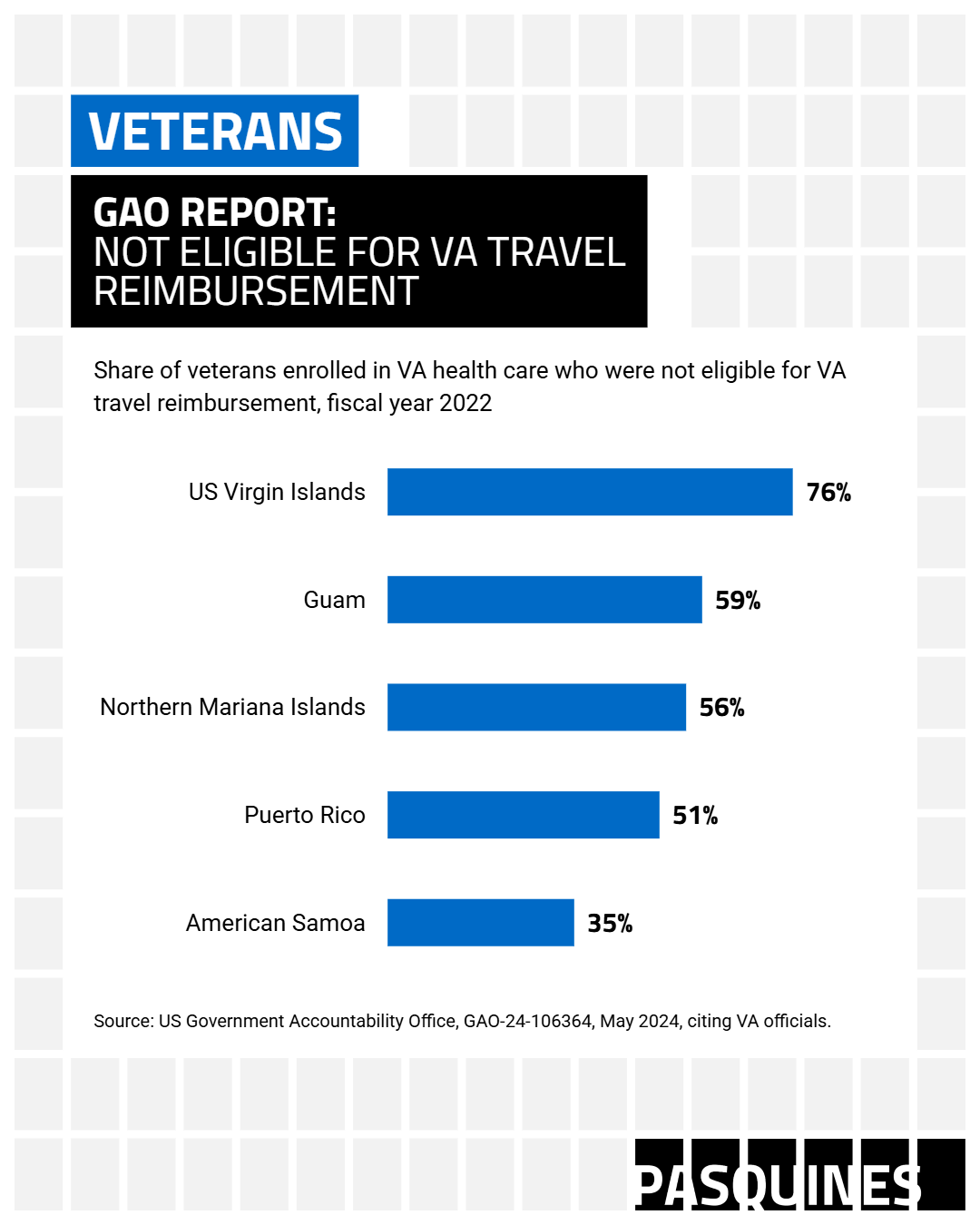
Many of those veterans cannot get the cost of the trip back. As of fiscal year 2022, 76% of enrolled veterans in the US Virgin Islands were not eligible for VA travel reimbursement, along with 59% in Guam, 56% in the Northern Mariana Islands, 51% in Puerto Rico, and 35% in American Samoa. The GAO recommended that the VA consider expanding eligibility for service-connected disabled veterans in the territories. In June 2025, the VA decided against it, citing its desire to ensure equity with all US veterans.
- US Virgin Islands76%
- Guam59%
- Northern Mariana Islands56%
- Puerto Rico51%
- American Samoa35%
Source: US Government Accountability Office, GAO-24-106364, May 2024, citing VA officials.
On Saipan, the VA lists a clinic that is open two days a week. Delegate Kimberlyn King-Hinds (R) of the Northern Mariana Islands wrote in February 2025 that “having only 2 medical care providers is not enough to see the hundreds of veterans in the Marianas.” That May, she introduced the Territorial Response and Access to Veterans’ Essential Lifecare (TRAVEL) Act, which would let the VA assign traveling physicians to remote territories for up to a year. “Too often, veterans are forced to travel thousands of miles for basic care,” she said.
In American Samoa, the VA clinic added a behavioral health clinic, more specialty care, and expanded laboratory services in January 2025, with the aim of reducing veterans’ trips to O‘ahu or the mainland. Veterans’ care also came up in the territory’s November 3, 2026, delegate race, in which Fualaau Rosie Tago Lancaster, a US Army veteran, campaigned on a hospital wing for veterans.
On Guam, the VA opened a roughly 6,000-square-foot clinic annex in Dededo on June 22, 2026, offering primary care, prosthetic support, laboratory services, and in-person mental health care. Cesar Cabot, the attorney who developed the building, said it is the first VA clinic on Guam outside military property. Thomas Steinbrunner, executive director of the VA Pacific Islands Health Care System, said its primary care teams on Guam have grown from one, when services began at Naval Hospital Guam, to seven. About half of Guam’s veterans are enrolled in VA health care, The Guam Daily Post reported. The Post recounted the case of Johnny Taitano, a Vietnam veteran who had a second heart attack in June 2015 before an urgent referral to Tripler could be finalized; he later had bypass surgery there. “Our medical infrastructure on Guam has never been the best in the world,” said Dr. Kevin McDermott, chief medical officer and chief of operations for the VA in Guam and the Northern Mariana Islands.
Guam falls under the VA regional office in Honolulu, “nearly 4,000 miles away,” Moylan’s office said in March 2026, when he announced that 16 members of Congress supported a VA regional office on Guam and that he planned to introduce legislation requiring one. In June 2025, the US House passed his amendment to its fiscal 2026 military construction and VA spending bill, HR 3944, directing the VA to prepare for a permanent, full-service regional office on Guam. Moylan lost his reelection bid to Alicia Limtiaco (D), a former attorney general of Guam, in the November 3 election, according to unofficial results. Limtiaco campaigned on equal treatment for Guam under federal programs, including veterans’ care.
Cuts, shortages, and repairs
Nationally, the VA has shrunk. In July 2025, the department said it was on pace to cut nearly 30,000 employees by the end of that fiscal year through attrition, early retirements, deferred resignations, and the federal hiring freeze, while ruling out a department-wide reduction in force. “VA is headed in the right direction,” said US Secretary of Veterans Affairs Doug Collins. On November 11, 2026, ProPublica reported that the VA had around 5,100 fewer doctors, nurses, and other “mission critical” staff than when President Donald Trump (R) took office in January 2025, a 3.4% drop. Its investigation documented a crisis at the VA hospital in East Orange, New Jersey, which lost nearly a tenth of its staff and where the operating room closed nine times in a year, compared with once the year before.
In September 2026, the VA’s Office of Inspector General reported that VA health care facilities had designated 4,712 severe occupational staffing shortages, the most in seven years, and that all 139 facilities reported at least one. The VA Caribbean Healthcare System in San Juan reported 90, 88 of them in clinical occupations ranging from anesthesiology to neurosurgery. That was nearly as many as East Orange, with 91, and well above the national average of about 34. The VA Pacific Islands Health Care System in Honolulu reported 17. The inspector general noted that a shortage designation “does not necessarily indicate the presence of vacancies.” VA Press Secretary Quinn Slaven said the report “is not based on actual VA healthcare facility vacancies and therefore is not a reliable indicator of staffing shortages,” and that VA-wide vacancy rates were 15% for doctors and 9% for nurses. He also told ProPublica the VA had a record number of appointments for both direct and private care over roughly the past year.
Staffing in the Pacific territories was a concern before then. A February 2023 GAO report found that the VA “faces difficulties ensuring it has the appropriate workforce to meet the current and future needs of veterans” there. Vacancies at VA sites in American Samoa, Guam, and the Northern Mariana Islands fell from 32 in fiscal year 2019 to 18 in fiscal year 2021, then rose to 34 in fiscal year 2022, and Guam accounted for 70% of the vacancies over those years. The VA employed 88 people across the three territories as of September 2022.
By June 2025, the VA had also terminated 585 contracts as part of an audit, CBS News reported. Roy Gamboa, a Marine Corps veteran who founded GOT YOUR 671, a Guam veterans group funded by a VA grant, worried his group could be next. “I refuse to believe that it was all for nothing,” he said. The VA told CBS News that the Guam clinic offers same-day emergency mental health care to patients in crisis on weekdays.
On April 28, 2025, US Virgin Islands officials traveled to Puerto Rico to meet VA Caribbean Healthcare System leaders about anticipated staff and service reductions. Tina Commissiong, chief executive of Schneider Regional Medical Center, committed to expanding the hospital’s participation in the VA Community Care Network, which lets eligible veterans receive VA-reimbursed care at local hospitals and clinics.
In Puerto Rico, veterans warned in June 2025 that a reorganization at the VA Caribbean Healthcare System threatened mental health services. They said the mental health clinic in Guayama, which reportedly served about 500 veterans, would be relocated and that a music program used as therapy for post-traumatic stress disorder (PTSD) had been discontinued. Jorge Pedroza Rodríguez, president of the Puerto Rico chapter of Vietnam Veterans of America, estimated that 63 psychiatrists were serving nearly 30,000 patients seeking mental health care. The hospital said in a written statement that its PTSD clinic “remains fully operational” and that it had no plans to reduce mental health services.
The VA’s own figures for San Juan showed shorter waits that spring. The wait for primary care was 14.7 days in April 2025, down from 19.8 days a year earlier; general mental health waits fell from 15 to 8.4 days, and specialty care waits fell from 40.1 to 31.2 days, VA Press Secretary Pete Kasperowicz told Prism. The VA also said 22 probationary employees in Puerto Rico who had been laid off were reinstated, most of them by March 2025.
On May 12, 2026, Governor Jenniffer González-Colón (NPP, R) announced that the VA had approved projects at the San Juan medical center under a national modernization initiative. They include hurricane hardening at its generator plant, new CT scan and X-ray equipment, a gym for patients with spinal cord injuries, and moving its psychiatric intervention center closer to the emergency department. “These investments represent a strong commitment to the men and women who served our nation with honor,” she said.
Fewer local benefits
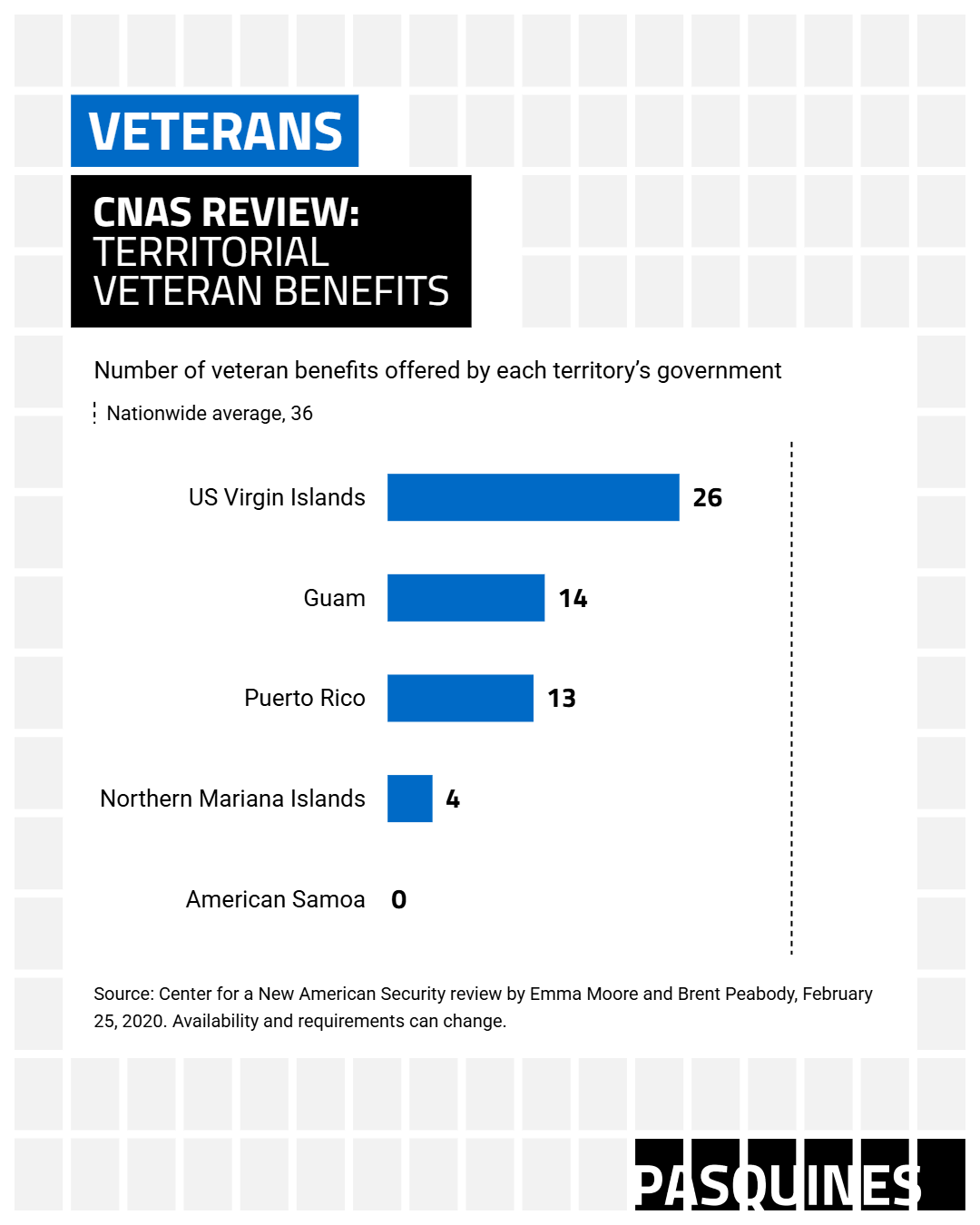
Territorial governments also offer fewer veteran benefits of their own. A 2020 review by the Center for a New American Security counted an average of 11 veteran benefits in the territories, compared with an average of 36 nationwide. The US Virgin Islands offered the most, 26, including a $20,000 property tax deduction and a $220,000 low-interest loan for a first home. Guam offered 14, Puerto Rico 13, the Northern Mariana Islands four, and American Samoa none. The authors cautioned that availability and requirements can change.
Nationwide average, 36
- US Virgin Islands26
- Guam14
- Puerto Rico13
- Northern Mariana Islands4
- American Samoa0
Source: Center for a New American Security review by Emma Moore and Brent Peabody, February 25, 2020. Availability and requirements can change.
“They don’t care for me”
In June 2023, after Congress required one in a defense bill, the VA created an advisory committee on veterans in Puerto Rico, Guam, American Samoa, the Northern Mariana Islands, the US Virgin Islands, and the three freely associated states. It met for the first time that December. Alex Ortiz, an Army veteran who advocates for veterans in Puerto Rico and is one of the islands’ three representatives on the committee, told The War Horse, “A lot of veterans … get to a point where they’re like, ‘They don’t care for me.’” He added, “We’re frustrated.”
In American Samoa, the enlistments continue. On September 10, 2025, 33 people took the oath of enlistment at the Army Reserve Center in Pago Pago as more than 100 friends and relatives watched. “It is unlike anything you’ll see anywhere else in recruiting,” said Lieutenant Colonel John Scott, commander of the Army’s Portland-Pacific Recruiting Battalion, who administered the oath.


Be the first to add context