

The government of the United States Virgin Islands loaded $539,891 in replacement food benefits onto the cards of 3,755 households on St. Thomas and St. John on November 7, 2026, to cover groceries lost during the power outages that began October 21, the US Virgin Islands Department of Human Services announced. Families did not have to apply. The United States Department of Agriculture (USDA) approved a waiver on November 5 that let the department skip the usual paperwork and pay active Supplemental Nutrition Assistance Program (SNAP) households in seven St. Thomas and St. John ZIP codes at once.
Each household received 30% of the SNAP benefits it got in the month before the outages, rounded up to the nearest dollar, or about $144 on average. Governor Albert Bryan Jr. (D) described the relief at his weekly US Virgin Islands Government House briefing on November 9. “For families already struggling to make ends meet, losing a refrigerator full of groceries is a serious financial burden,” he said. “We didn’t want people standing in lines or filling out paperwork to replace food they lost because of the outages.”
Days without power
The outages started the night of October 21. The next day, the US Virgin Islands Water and Power Authority (WAPA) announced rotating outages across St. Thomas and St. John, blaming problems with two generating units. Districtwide outages followed on October 23 and 24, and WAPA did not restore all its feeders until late on October 24, Pasquines reported. Bryan authorized Human Services Commissioner Averil George to seek federal approval to help SNAP recipients who lost food.
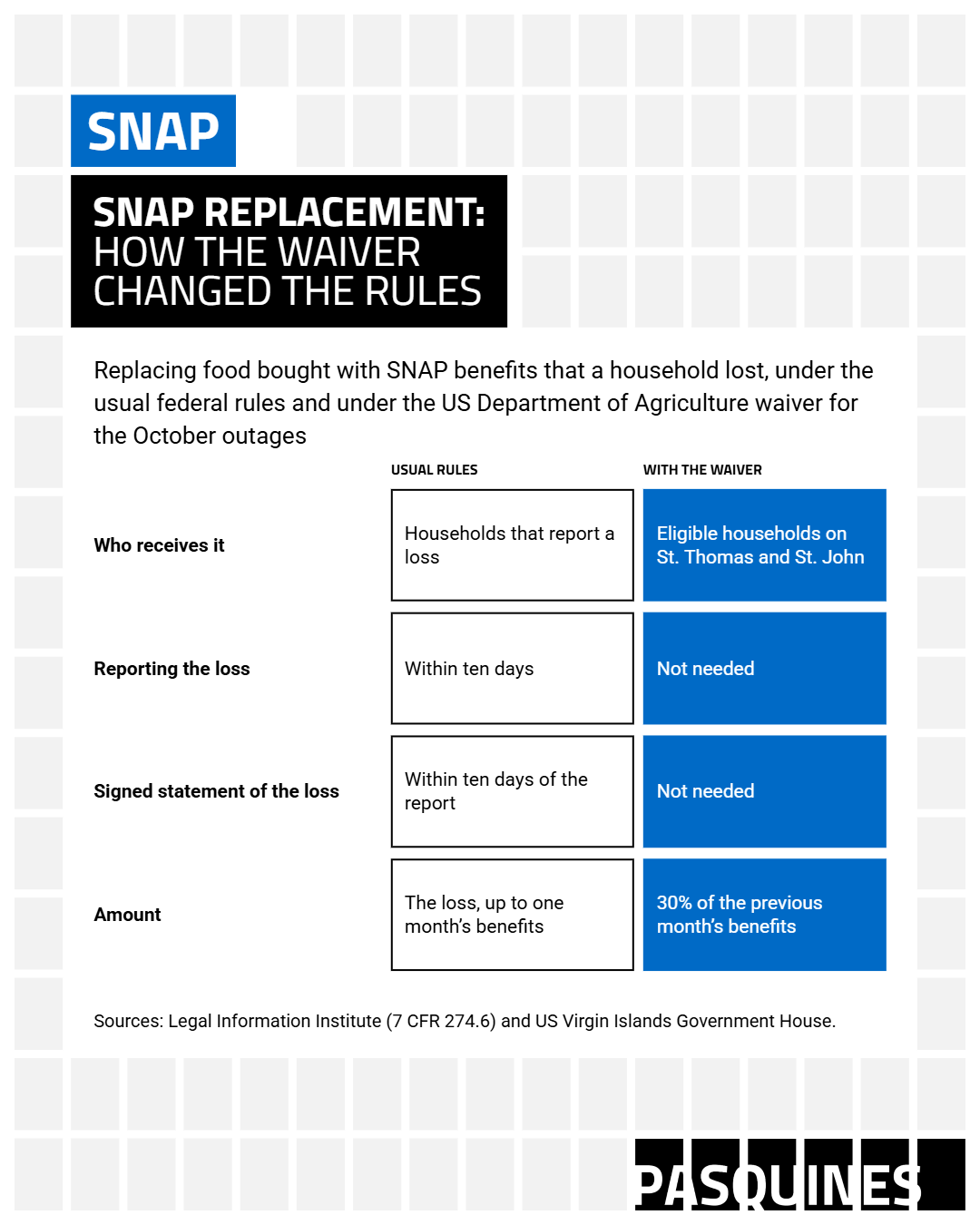
Under federal rules, a household that loses food bought with SNAP benefits must report the loss within ten days and return a signed statement within ten days of that report, and the replacement cannot exceed one month’s benefits. The waiver removed those steps for the district. “By securing this federal waiver, we were able to completely automate the replacement process, bypassing the standard requirement for individual households to visit our offices and sign affidavits,” George said.
- Who receives itUsual rules: Households that report a lossWith the waiver: Eligible households on St. Thomas and St. John
- Reporting the lossUsual rules: Within ten daysWith the waiver: Not needed
- Signed statement of the lossUsual rules: Within ten days of the reportWith the waiver: Not needed
- AmountUsual rules: The loss, up to one month’s benefitsWith the waiver: 30% of the previous month’s benefits
Sources Legal Information Institute
 US Virgin Islands Government HouseUsual rules: 7 CFR 274.6. Waiver: US Virgin Islands Government House, November 9, 2026.
The US Virgin Islands and Guam take part in SNAP, while Puerto Rico receives a federal block grant for its own Nutrition Assistance Program. More than 15,000 Virgin Islanders rely on SNAP, out of a population of about 87,000, the VI Consortium reported in July 2025. The territory will soon pay more to run the program. Under the One Big Beautiful Bill Act, signed that month, the federal share of SNAP administrative costs falls from 50% to 25% starting in 2027, and beginning in fiscal year 2028, states and territories with payment error rates above 6% will have to cover part of the benefits.
Bryan thanked George’s team and acknowledged that the territory still needs more reliable electricity. Repairs to key generating units and new temporary generation for St. Thomas and St. John are not expected before 2027.
Opportunity Zones in all three islands
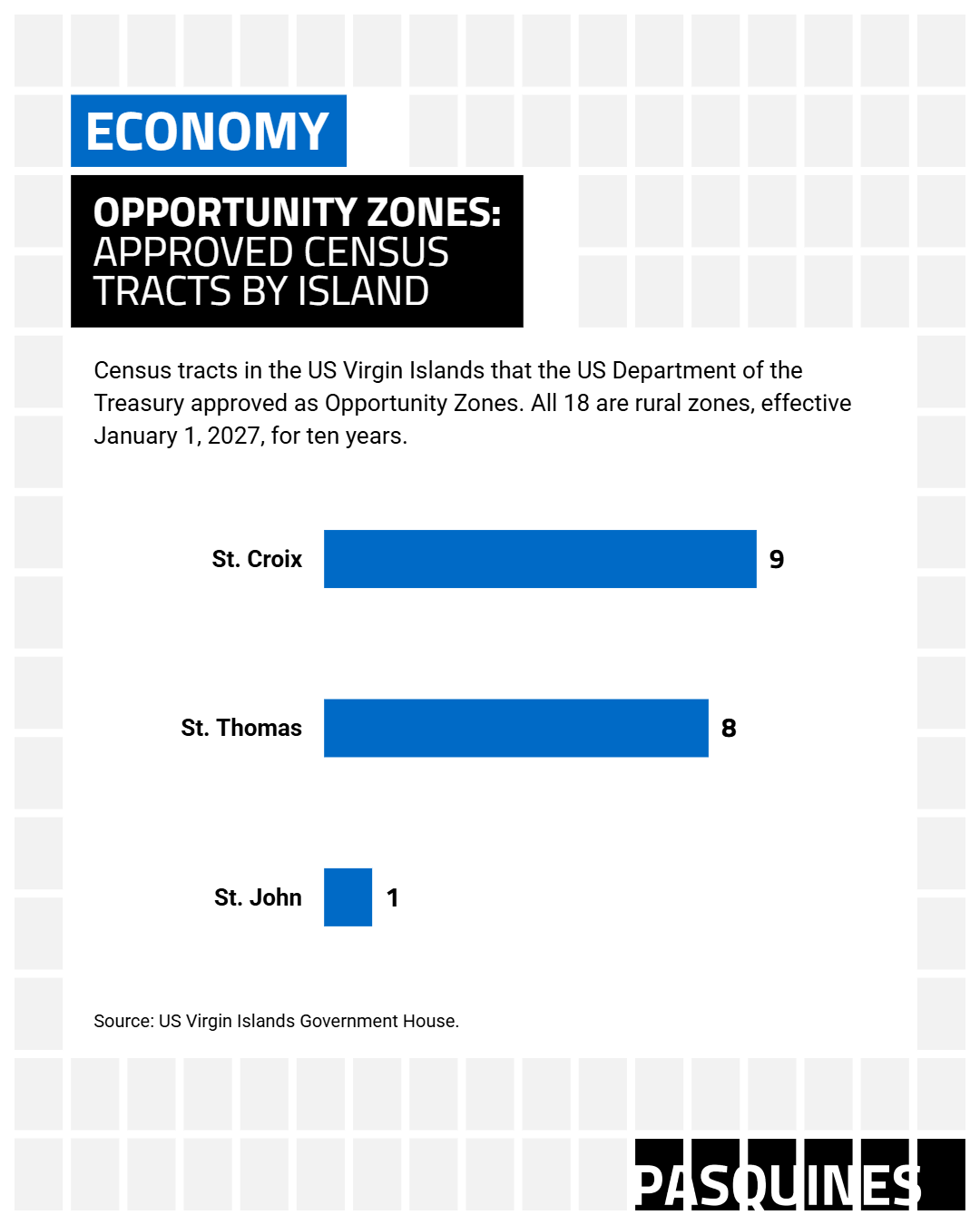
At the same briefing, Bryan said the US Department of the Treasury had approved all 18 census tracts his administration nominated as Opportunity Zones, which offer federal tax incentives to encourage private investment in designated areas. Nine are on St. Croix, eight on St. Thomas, and one on St. John, and all 18 qualify as rural Opportunity Zones.
On St. Croix, the zones include parts of Christiansted, Frederiksted, Kingshill, and the South Shore, among them the former HOVENSA refinery and Renaissance properties. On St. Thomas, they include Tutu, Anna’s Retreat, Smith Bay, Crown Bay, Havensight, and Charlotte Amalie. Cruz Bay and nearby communities on St. John are included for the first time.
- St. Croix9
- St. Thomas8
- St. John1
The designations take effect January 1, 2027, and last ten years. They are part of a new round the Treasury and the US Internal Revenue Service announced for more than 6,500 communities after the 2025 tax law made the incentive permanent. Investments in rural zones receive a 30% increase in their tax basis after five years, compared with 10% elsewhere. “Government cannot build this economy by itself,” Bryan said. “But getting the designation is only the beginning. What matters is turning those opportunities into real investments that benefit Virgin Islanders.”
Veterans Drive clears a federal hurdle
Bryan also announced an agreement with the US Coast Guard that removes a federal property obstacle to the second phase of the Veterans Drive Improvement Project on the Charlotte Amalie waterfront, a project the administration values at about $100 million. The first phase was completed in 2021. The second would widen the road around the Legislature of the US Virgin Islands to four lanes, add a tree-lined promenade, improve drainage, and strengthen the seawall.
The pre-solicitation period runs through November 19, and the solicitation period through January 13, 2027. Final property surveys, appraisals, and other approvals are still pending. Bryan, who leaves office when Governor-elect Stacey Plaskett (D) takes office on January 4, 2027, acknowledged the timeline. “We’re not going to finish every project before we leave office, but we can make sure the next administration has something solid to build on,” he said.
Faster payments for vendors, for a fee
Bryan also announced a voluntary partnership with Municipal Vendor Services Inc. (MVSI) that would let businesses that sell goods and services to the government get paid as soon as 72 hours after an invoice is approved. US Virgin Islands Government House said the program is meant to address longstanding concerns about late government payments, particularly among small businesses. “When you’re running a business, you have employees to pay and bills coming due. You can’t tell your employees to wait until the government pays you,” Bryan said. “We know our payment cycles have been a challenge.”
The program comes at a cost to vendors. MVSI Chief Executive Officer Theodore Ellenis told the St. Croix Source that the company would use lender financing to buy approved invoices, pay businesses 95% of their value, and collect the full amount from the government. A vendor with a $10,000 invoice would receive $9,500. Ellenis said the government would pay no added interest or fees. Bryan said the government pays 7.5% when it uses its bank line of credit to cover vendor payments.
The partnership has also drawn scrutiny. Municipal Vendor Services Inc., Ellenis, and Chief Financial Officer Robert Miragliotta are defendants in a federal securities lawsuit filed in New Jersey in March 2025 by Discover Growth Fund II, a fund based on St. Thomas, over its investment in an earlier company where the two executives held leadership roles. The territory’s agreement is with a separate entity, MVSI USVI SPE, LLC, which is not named in the suit, the Source reported. Ellenis disputed the allegations and said they do not affect the local program. Asked how much the government owes vendors, Bryan said he did not have the figure readily available.


Be the first to add context