

Over 400 ocean policy and environmental justice advocates gathered in Washington, DC, for Upwell 2026: A Wave of Ocean Justice, a two-day conference that placed the experiences of US territory communities at the center of ocean conservation discussions.
Leaders from Guam, the Northern Mariana Islands, American Samoa, and Puerto Rico used the gathering to highlight the realities of colonial rule and unilateral federal decision-making, bringing territorial perspectives to a field where they have historically been excluded.
The conference opened with a panel on decolonizing ocean conservation, moderated by Dr. Frances Colon, senior fellow at the Center for American Progress. Panelists included Dr. Adi Martínez-Román, co-director of Right to Democracy; Dr. Austin Shelton, director of the University of Guam Center of Island Sustainability; Dr. Steven Mana’oakamai Johnson, assistant professor at Cornell University from the Northern Mariana Islands; and Representative Jose “Che” Perez Cordero (NPP, D) of the Puerto Rico House of Representatives.
The panel examined what emerging environmental conservation practitioners can learn from territory communities and how to integrate Indigenous and local expertise into decision-making. Panelists emphasized that meaningful conservation must begin with the people who live in territorial communities, given that they face unique environmental challenges and economic pressures while lacking democratic representation to influence decision-makers.
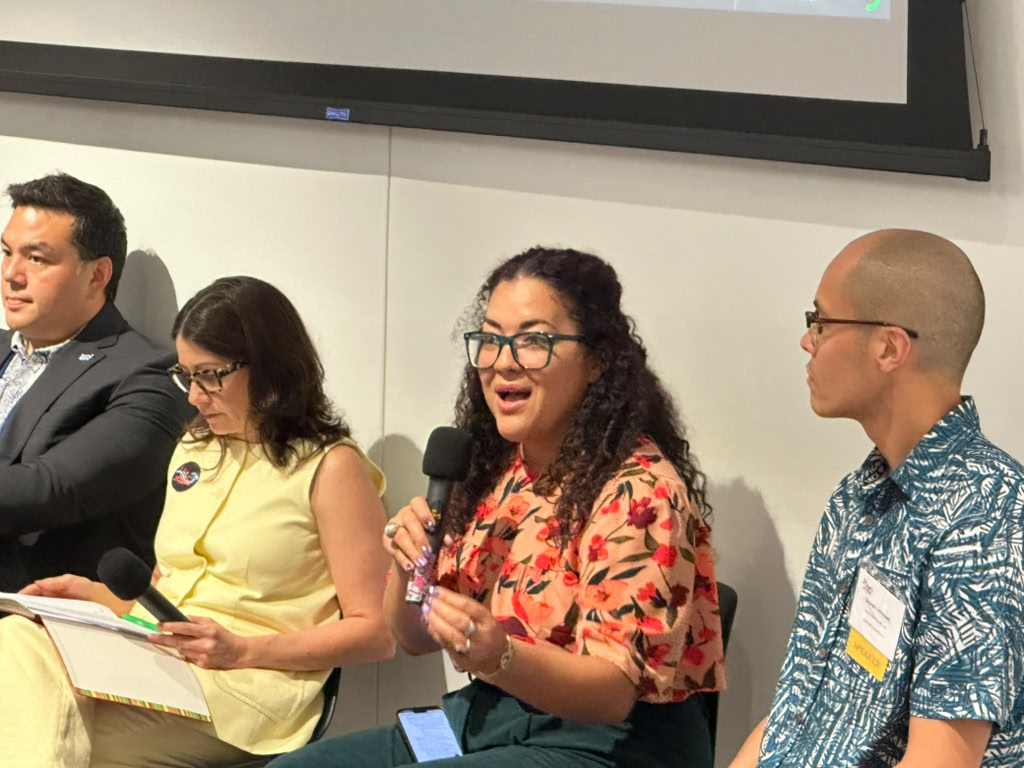
“As a result of the colonial legal framework, the people of the territories face the environmental consequences of imposed unilateral decisions,” Martínez-Román said. “Yet local and Indigenous communities in the territories continue to create—through solidarity and coalition building—innovative solutions to their unique challenges. This community-led work in US territories can provide a lesson to everyone dedicated to ocean conservation work.”
A second panel addressed deep-sea mining and featured Sabrina Suluai-Mahuka, founder of American Samoa-based environmental organization Finafinau and Right to Democracy Advocacy Fellow; JV Lankilde, associate at Earthjustice from American Samoa; and Angelo Villagomez, senior fellow at the Center for American Progress from the Northern Mariana Islands, who co-led the conference. Together, the organizations represented at the conference helped submit tens of thousands of comments and letters in opposition to the imposition of deep-sea mining.
“The US territories are home to 30% of all US oceans, so it is fitting that the people who live there and call our islands home should be in ocean conferences in Washington, DC, where a lot of decisions are made on our behalf,” stated Villagomez.
Dr. Suluai-Mahuka also delivered the conference’s keynote address, centering the perspective of Pacific Island communities.
“Governments derive their legitimacy from the consent of the governed, not the other way around. We spoke in testimony, in public comments, in village meetings, on fishing boats, along shorelines. And still we are told to trust the process. But trust is not built by speeding up decisions after communities raise concerns. Trust is built when power listens, and listening requires changing course when those words tell you no,” Suluai-Mahuka said.
Guam artist Gillian Dueñas was also featured at the conference.
Martínez-Román said Right to Democracy planned to brief Congress on how the imposition of deep-sea mining and other unilateral federal policies violates the principle of consent of the governed.
“Over the last year, Right to Democracy has worked alongside our community partners across the territories to ensure the voices of our communities are heard at the Bureau of Ocean and Energy Management at the Department of Interior and in the halls of Congress,” Martínez-Román said.

0 Comments