

Residents of St. Thomas and St. John are heading into Thanksgiving under rotating power outages that have run on and off since October, and St. Croix joined them this week after a propane terminal failure forced the US Virgin Islands Water and Power Authority (WAPA) to conserve a limited diesel supply. “We know this is not the Thanksgiving week our community anticipated,” the utility said in a statement.
Karl Knight, WAPA’s chief executive officer, told US Virgin Islands senators on November 23 that he expected the outages to be resolved within seven to eight days. “I can’t see that being completed before Thanksgiving Day,” he said.
The outages have filled Pasquines’ social media channels with comments from readers. One reader wrote that rotations on St. Thomas and St. John often last four hours at a time, numerous times a day. Outages have disrupted life in the territory for years.
Generators failing one after another
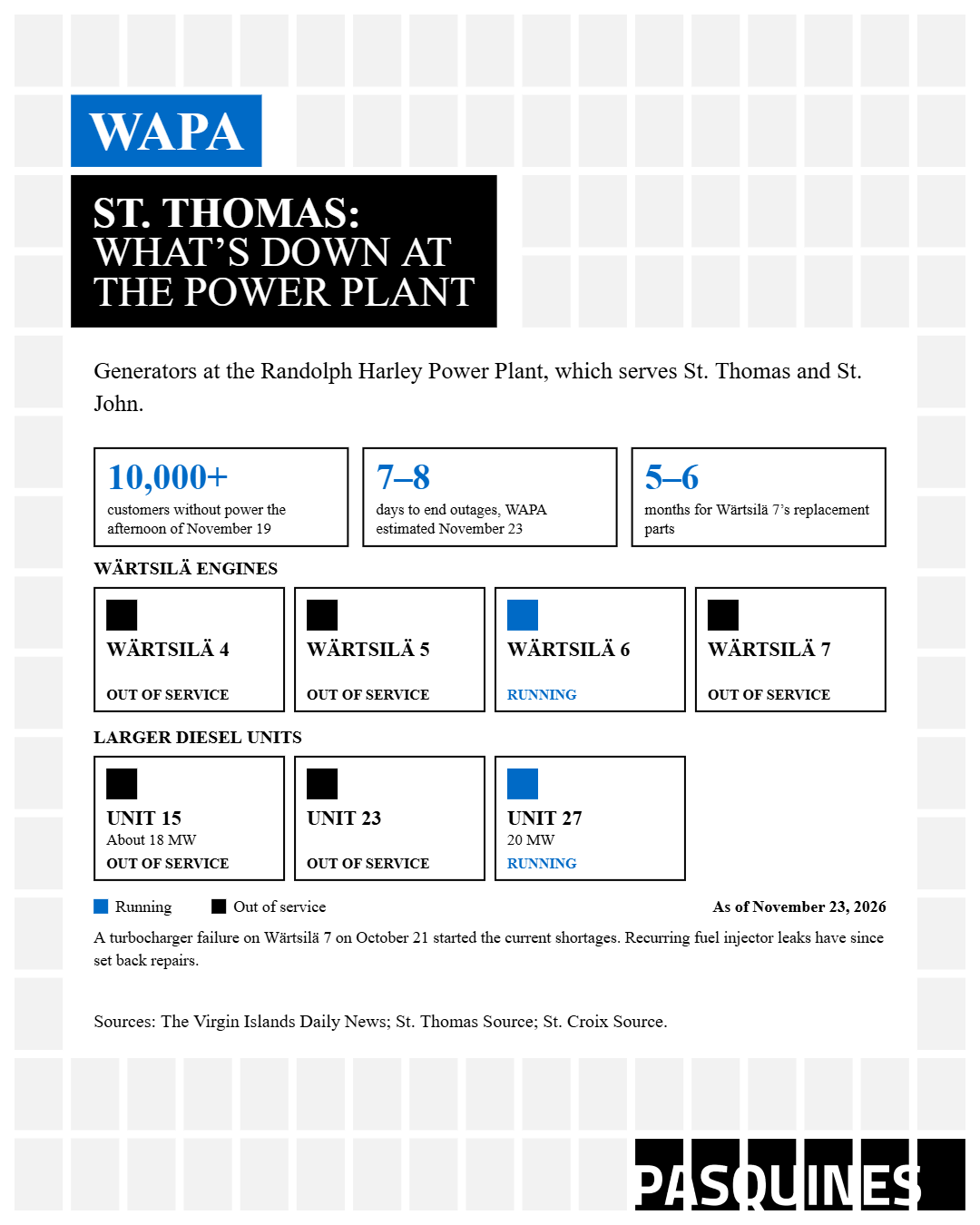
The shortages on St. Thomas and St. John began on October 21, when one of the Randolph Harley Power Plant’s Wärtsilä engines, Unit 7, suffered a turbocharger failure. Another Wärtsilä, Unit 5, had already been down for months with a broken turbocharger, and two other units were also out, Unit 15 since February and Unit 23 since May, leaving Unit 27 to carry much of the load after multiple emergency repairs over the past year. Power returned in late October after days of outages, but new generation remained months away, and 3,755 households on St. Thomas and St. John later received automatic replacement of their Supplemental Nutrition Assistance Program benefits after those outages.
Another Wärtsilä unit later tripped while crews worked on the others, setting off a cascading failure that took down Unit 27 and caused an island-wide outage, with some feeders out for 10 hours or more. More than 10,000 customers were without power on the afternoon of November 19. This week, mechanics and Wärtsilä technicians were chasing recurring fuel injector failures that let diesel leak into the engines’ lubricating oil, a setback that pushed back hopes of ending daylong rotations before the holiday. “We’re hoping to get back to a point where it’s just at peak as opposed to running it daylong,” Knight said.
The Wärtsilä engines were marketed as dual-fuel units but have never run successfully on liquefied petroleum gas, and an attempt in early 2025 ended in what WAPA’s project management director called a “catastrophic failure.” Knight told senators the utility was now paying for deferred maintenance. “It has foregone the required maintenance and upkeep of its infrastructure, and those chickens are now coming home to roost,” he said.
More than 10,00010,000+customers without power the afternoon of November 19
Seven to eight7–8days to end the outages, WAPA’s chief executive estimated November 23
Five to six5–6months for Wärtsilä 7’s replacement parts
Wärtsilä engines
Larger diesel units
Wärtsilä engines
Wärtsilä 4
Out of service. Crews were working to return it to service.
Wärtsilä engines
Wärtsilä 5
Out of service. It had been down for months with a broken turbocharger, and crews were working to return it to service.
Wärtsilä engines
Wärtsilä 6
Running. It was taken offline for repairs and returned to service November 12.
Wärtsilä engines
Wärtsilä 7
Out of service. A turbocharger failure on October 21 started the current shortages. Replacement parts are expected to take five to six months, although Wärtsilä has suggested a December return that WAPA’s chief executive said he had not verified.
Larger diesel units · About 18 MW
Unit 15
Out of service. One of the plant’s largest diesel generators, it has been down for repairs since early 2026, and work on it continues.
Larger diesel units
Unit 23
Out of service. One of the plant’s largest diesel generators, it has been offline since May.
Larger diesel units · 20 MW
Unit 27
Running, and carrying much of the load. It went offline October 21 and returned October 25. In November, a Wärtsilä engine tripped during repairs and set off a cascading failure that brought Unit 27 down and caused an island-wide outage.
Recurring fuel injector leaks have let diesel into the Wärtsilä engines’ lubricating oil, setting back repairs. The engines were touted as dual-fuel units, but WAPA has never run them successfully on liquefied petroleum gas.
Sources The Virgin Islands Daily NewsThe Virgin Islands Daily News · Nov. 19
 St. Thomas Source
 St. Croix Source
A fuel crunch on St. Croix
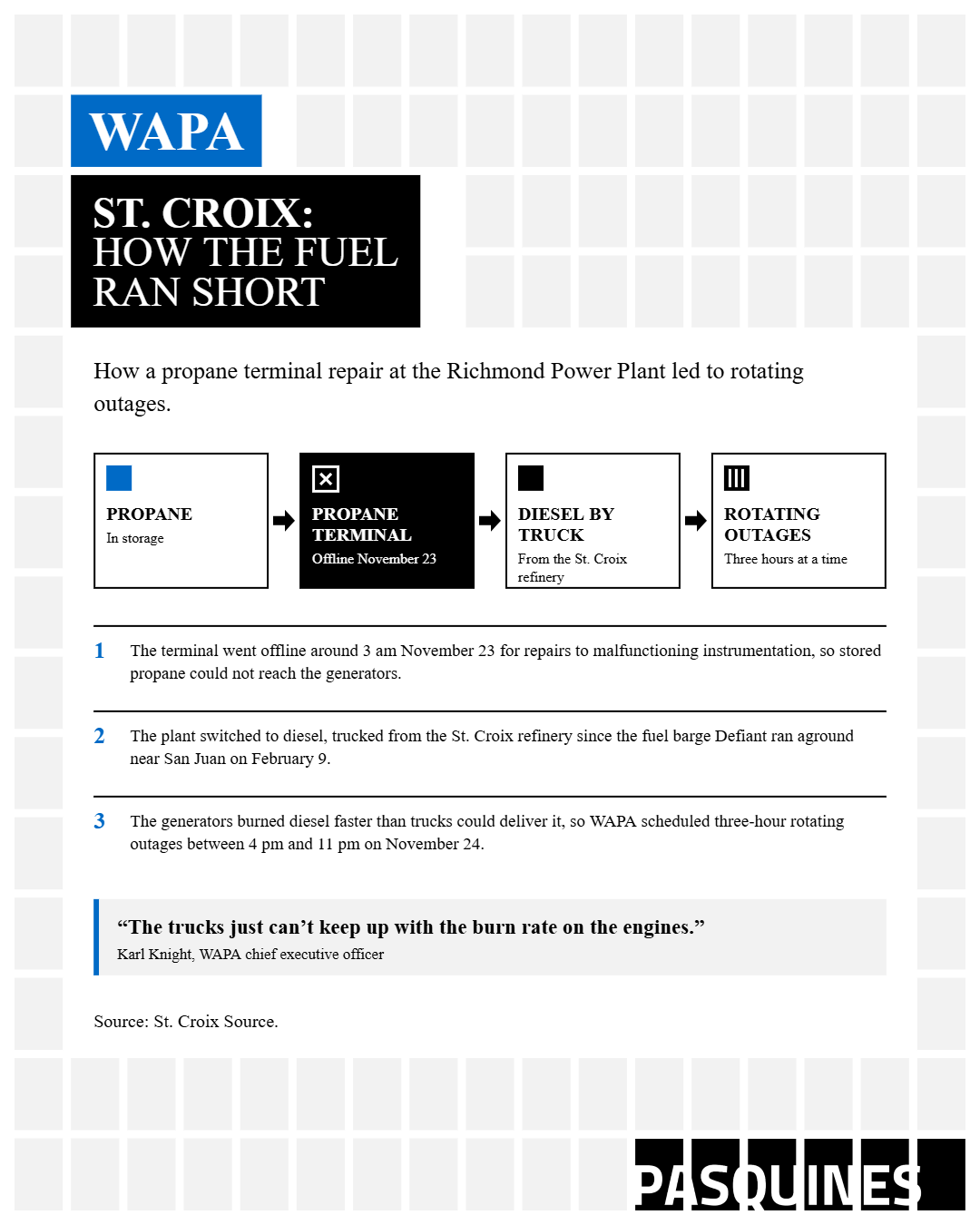
On St. Croix, the propane terminal at the Richmond Power Plant went offline at about 3 am on November 23 so its contractor, Saintnals, could repair malfunctioning instrumentation. The propane was in storage but could not reach the generators, so the plant ran on diesel, which it burned faster than trucks could deliver it. “The trucks just can’t keep up with the burn rate on the engines,” Knight said.
Step 1 of 4
Propane in storage
St. Croix primarily uses propane to generate electricity, and the tanks at the Richmond Power Plant were relatively well stocked.
Step 2 of 4
The terminal goes down
The propane terminal, operated by the contractor Saintnals, went offline around 3 am November 23 for repairs to malfunctioning instrumentation, so the propane could not reach the generators. A similar terminal problem November 18 had forced the plant onto diesel for a day.
Step 3 of 4
Diesel by truck
The plant switched to diesel, which has been trucked from the refinery on St. Croix since the fuel barge Defiant ran aground near San Juan on February 9. Financial constraints limit how much backup diesel WAPA keeps on hand.
Step 4 of 4
Rotating outages
The generators burned diesel faster than trucks could deliver it, so on November 24 WAPA scheduled three-hour rotating outages between 4 pm and 11 pm, turned to local fuel vendors, and leaned on three solar farms during the day.
“The trucks just can’t keep up with the burn rate on the engines.”
Karl Knight, WAPA chief executive officer
SourcesSt. Croix Source
WAPA has relied on trucking diesel from the St. Croix refinery since the fuel barge Defiant ran aground near San Juan, Puerto Rico, on February 9. Its fuel supply has been a weak point before: in 2022, the utility warned of blackouts when Vitol stopped supplying propane. On November 24, the utility scheduled three-hour rotating outages between 4 pm and 11 pm, and some St. Croix feeders lost power from about 8:30 am, as WAPA turned to local fuel vendors and leaned on three solar farms during the day. A similar terminal problem on November 18 had already forced the plant onto diesel for a day.
WAPA blamed “financial constraints and ongoing under-recovery” for its thin diesel reserves. That explanation differs from earlier statements. On October 19, a WAPA spokesperson testified that the utility was short on cash but had enough diesel and liquefied petroleum gas in both districts, and on November 23, Knight told senators that none of the St. Thomas and St. John blackouts were caused by fuel shortages.
Stopgaps are weeks or months away
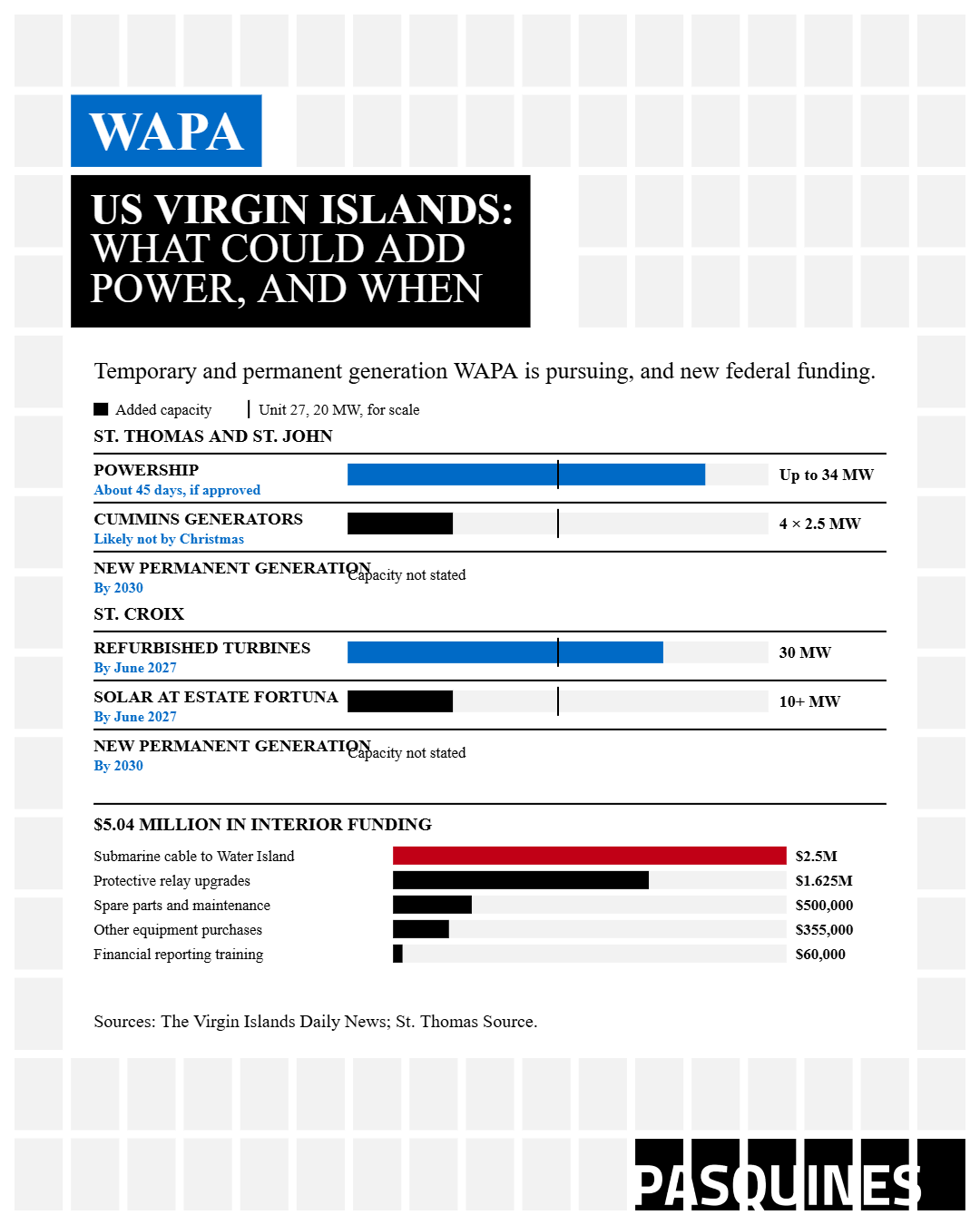
This month, Governor Albert Bryan Jr. (D) announced $5.04 million in federal funding from the United States Department of the Interior’s Office of Insular Affairs, including $2.5 million to replace the submarine power cable serving Water Island and $1.625 million for protective relay upgrades. “We still have significant challenges with generation capacity, and these funds alone will not solve those problems,” he said, estimating that temporary power options would take four to six weeks at best.
One option is a powership. WAPA is weighing a six-month lease of a vessel now anchored in the Dominican Republic that could supply up to 34 megawatts, with a $2.85 million mobilization payment and power at about 11 cents per kilowatt-hour, including a capacity payment owed whether or not the power is used. The deal still needs review and board approval, and the process would take about 45 days.
Four 2.5-megawatt Cummins generators meant for St. John, two for Coral Bay and two for Frank Bay, still need Coastal Zone Management approval, with a committee meeting planned for December 5, and the Federal Emergency Management Agency must approve installation plans before they can be moved without jeopardizing federal funding. Senators were told the generators likely would not arrive by Christmas. On St. Croix, three refurbished turbines adding 30 megawatts and at least 10 megawatts of solar at Estate Fortuna are expected by June 2027, and new permanent generation at both power plants is planned by 2030.
St. Thomas and St. John
- PowershipKPS 51, anchored in the Dominican Republic
Up to 34 MW
About 45 days, if approved
A six-month lease with a $2.85 million mobilization payment and about 11 cents per kilowatt-hour, including a capacity payment owed whether or not the power is used. It still needs review and board approval.
- Cummins generatorsFor St. John: two for Coral Bay, two for Frank Bay
4 × 2.5 MW
Likely not by Christmas
They still need Coastal Zone Management approval, with a committee meeting planned for December 5, and FEMA approval of the installation plans.
- New permanent generationAt the Randolph Harley Power Plant
By 2030
Planned new permanent generation at the plant.
Governor Albert Bryan Jr. (D) said temporary power options would take four to six weeks at best. WAPA’s chief executive estimated November 23 that repairs to the Wärtsilä engines could end the rotating outages within seven to eight days.
St. Croix
- Refurbished turbinesThree units at the Richmond Power Plant
30 MW
By June 2027
Three refurbished turbines to be installed at the Richmond plant.
- Solar at Estate FortunaAt least 10 MW
10+ MW
By June 2027
At least 10 megawatts of solar power to be connected.
- New permanent generationAt the Richmond Power Plant
By 2030
Planned new permanent generation at the plant.
$5.04 million from the United States Department of the Interior’s Office of Insular Affairs
- Submarine cable to Water Island$2.5M
- Protective relay upgrades$1.625M
- Critical spare parts and maintenance$500,000
- Other equipment purchases$355,000
- Federal financial reporting training$60,000
“We still have significant challenges with generation capacity, and these funds alone will not solve those problems,” Bryan said. Other equipment purchases are the remainder of the $5.04 million total.
SourcesThe Virgin Islands Daily NewsSt. Thomas SourceSt. Thomas Source · funding
An emergency fight during the transition
Governor-elect Stacey Plaskett (D), the territory’s delegate to Congress, has demanded that Bryan declare an emergency, calling the outages a public health and economic crisis. “Letters do not generate electricity. Meetings do not keep businesses open, and promises do not keep the lights on,” she said. In an October 25 letter, she suggested an emergency order under Section 202(c) of the Federal Power Act, which lets the United States secretary of energy direct temporary measures during electricity shortages, could allow WAPA to run generators subject to restrictions and use backup generators at hotels and businesses to ease demand on the grid. Plaskett has said she will declare an emergency when she takes office on January 4, 2027.
Bryan has refused, arguing that WAPA already has federal funding, technical assistance, and generators, and that the real constraint is the time repairs take. “What we need is time,” he said. Knight told senators he would support a declaration only if it came with additional resources. The territory’s last local emergency for WAPA ended in December 2024.


Be the first to add context