

On November 3, 2026, voters in four United States territories elect delegates to the US House who can serve on committees but cannot vote in the House itself. In three of those territories, most registered voters in Pasquines’ October 2026 Elections Territorial Poll said they prefer to keep the territorial status that makes it so.
That status shapes far more than the ballot. Residents of the territories cannot vote for president in the general election. Their Medicaid programs run on federal funding capped each year, unlike the open-ended funding states receive, and residents of four of the five territories are excluded from Supplemental Security Income (SSI), the federal benefit for older and disabled people with little or no income. This fall, federal agencies are also making decisions on the territories’ tourism, oceans, and census count.
Some in the territories have defended the status for what it protects, including land and culture, while efforts to change it have stalled in Congress and the courts. The poll did not ask respondents why they chose a status, and the debate takes a different shape in each territory.
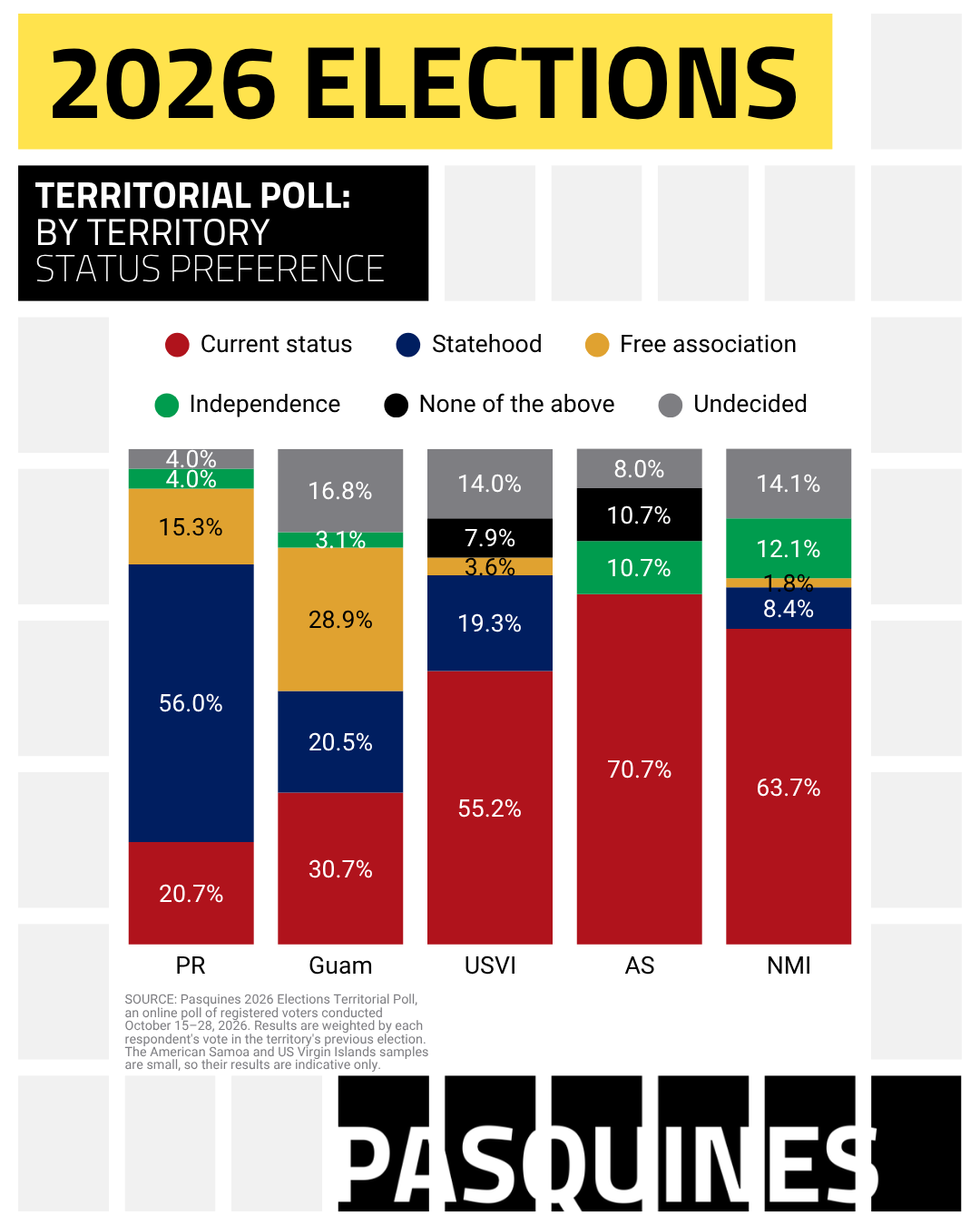
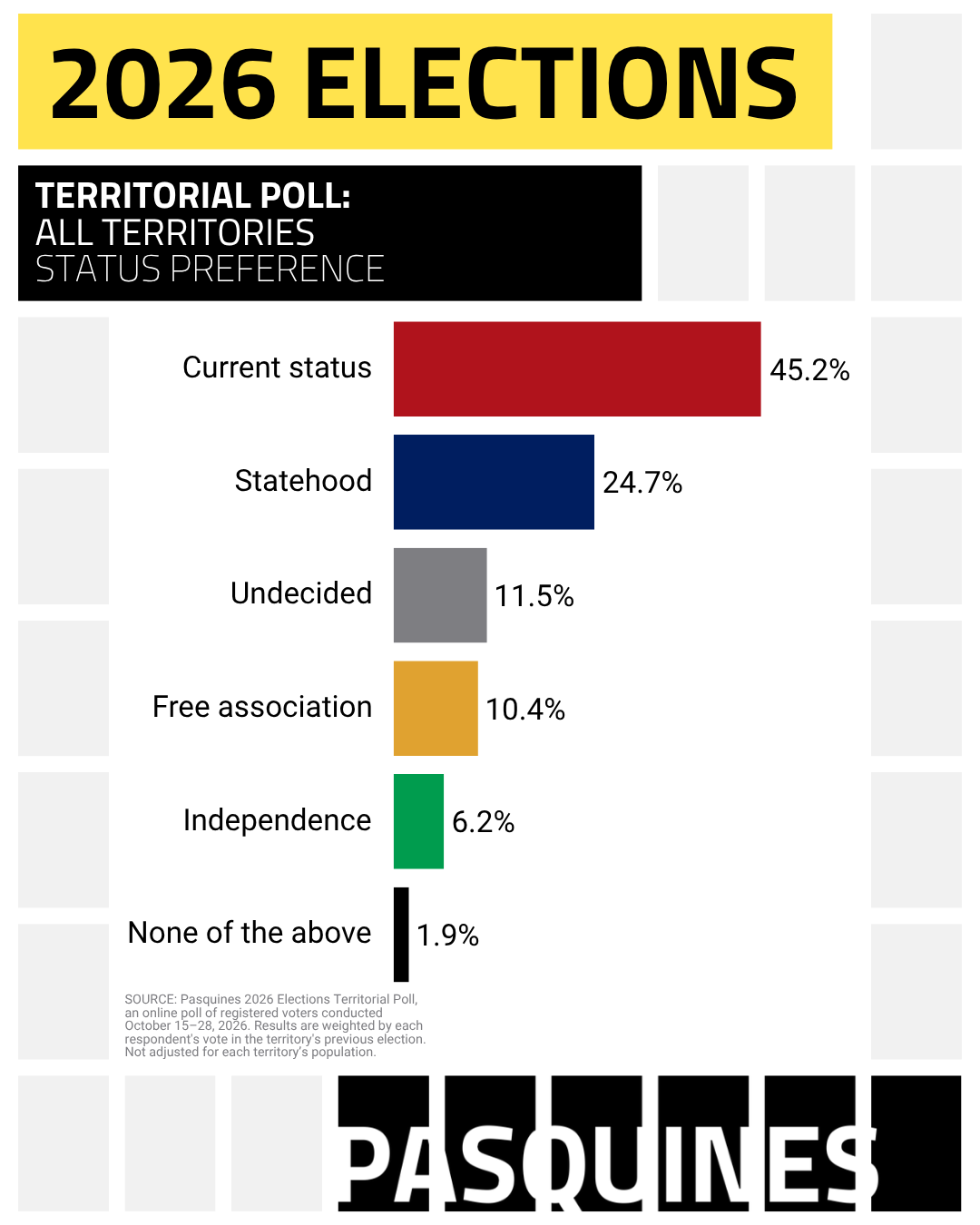
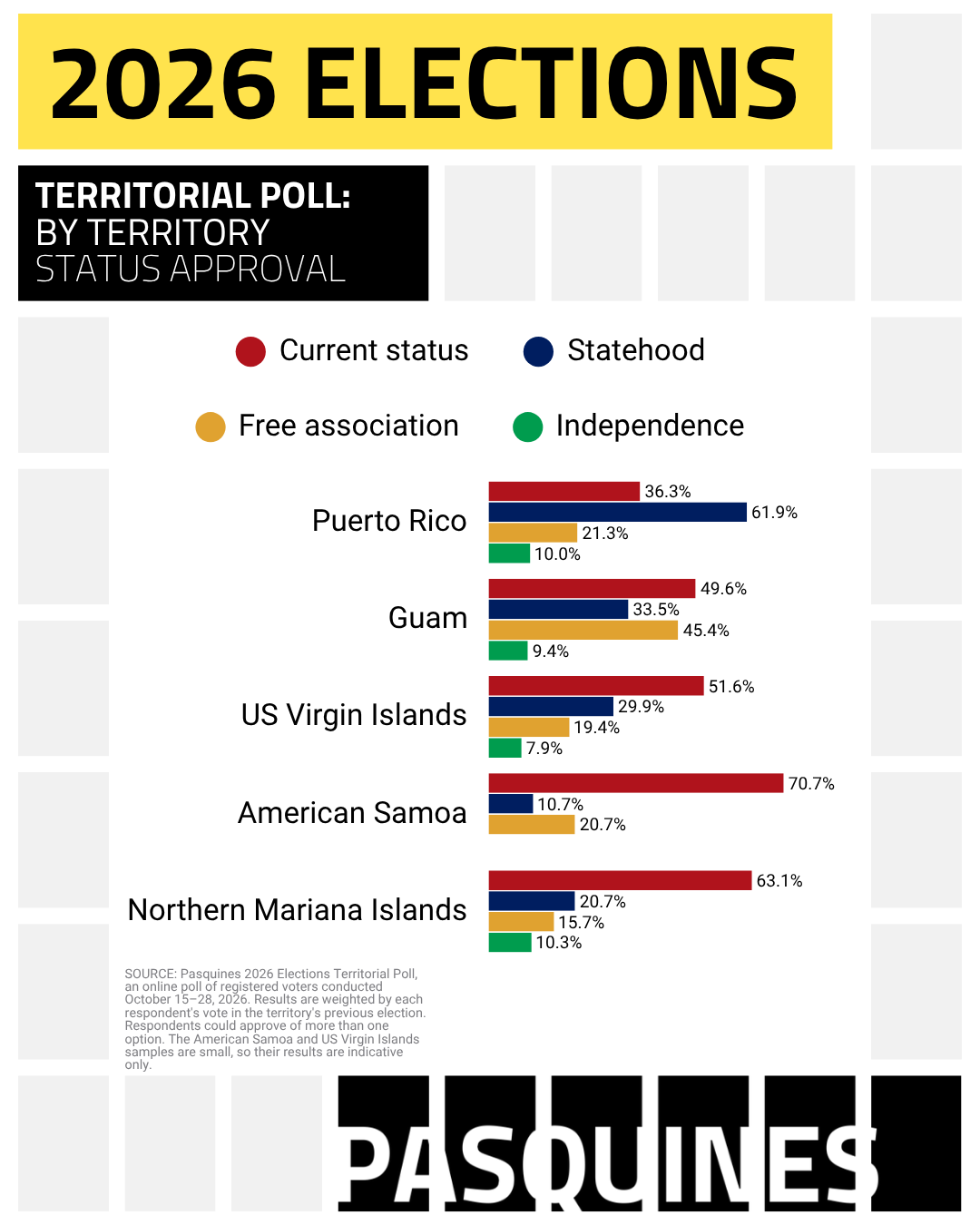
Puerto Rico, which votes next in 2028, was the only territory where a different status came out on top: 56.0% of respondents there preferred statehood. Elsewhere, the current status led, with 70.7% in American Samoa, 63.7% in the Northern Mariana Islands, and 55.2% in the US Virgin Islands. Guam was split between the current status and free association. Across all five territories, 45.2% preferred the current status and 24.7% statehood. Those combined figures add up weighted responses from each territory without adjusting for population, so they describe the poll’s respondents rather than the territories’ combined electorate.
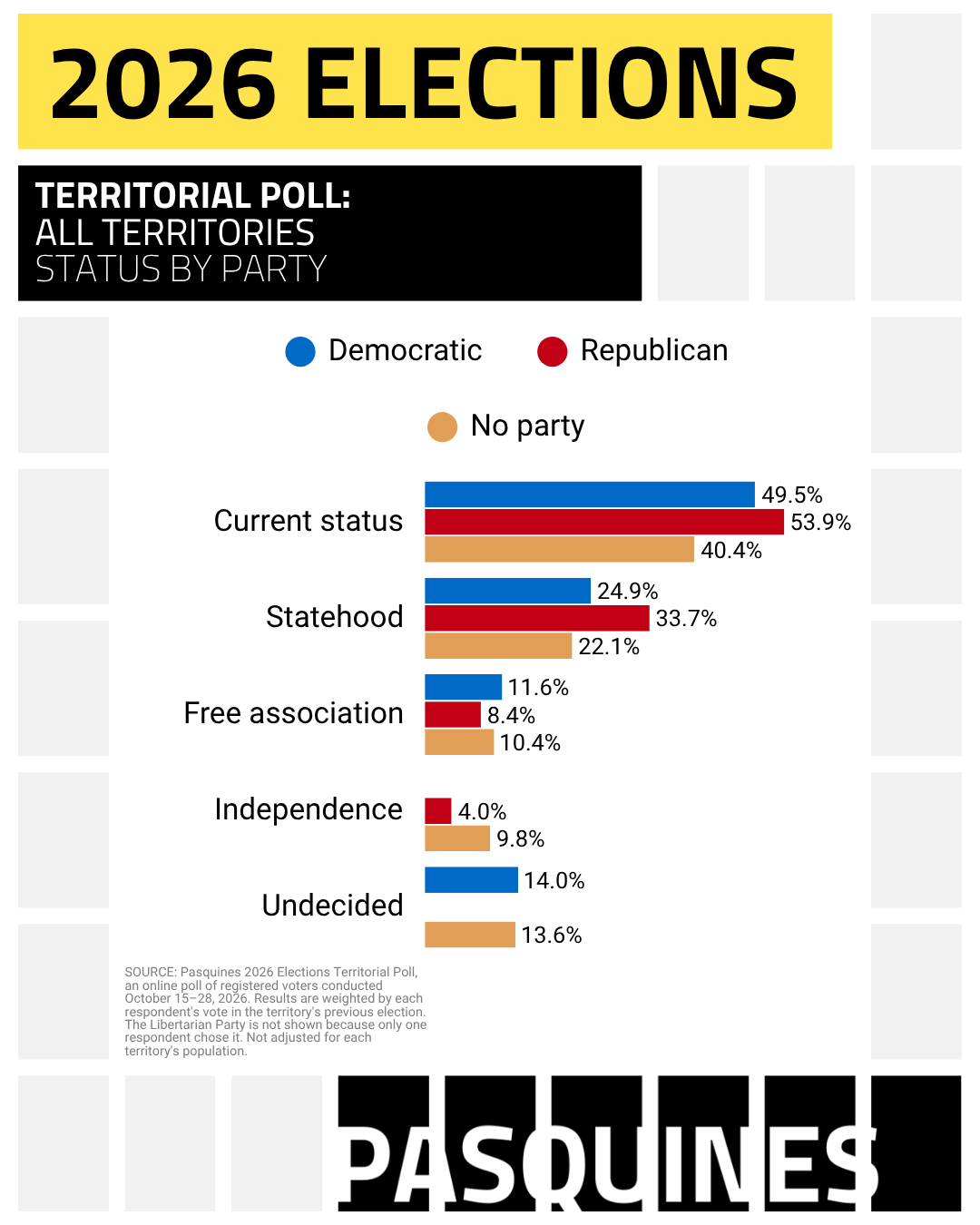
Support for the current status crossed party lines. It was the top choice of respondents affiliated with the Democratic Party (49.5%), the Republican Party (53.9%), and no national party (40.4%).
In American Samoa, protecting fa’a Samoa
American Samoa, the poll’s smallest sample, showed the strongest attachment to the current status, and no respondent there chose statehood as a preference. American Samoans are US nationals, not citizens, and their government has opposed changing that in court. When a group of American Samoans sued for birthright citizenship, the territorial government told the US Supreme Court in a 2022 brief that imposing citizenship “regardless of their wishes” would “deprive the American Samoan people of their fundamental right to self-determination,” Pacific Island Times reported. “There is nothing American Samoa treasures more than fa’a Samoa,” the brief said. Fa’a Samoa, the Samoan way, rests on an extended family system, called aiga, and communally held land controlled by a chief, called a matai. Some American Samoans have worried that citizenship could bring legal scrutiny to rules limiting the sale of communal land to people with at least half-Samoan ancestry, NPR reported. The court declined to hear the case.
The waters 3 to 200 miles off its shores, however, fall under a federal leasing process. On October 20, the federal Marine Minerals Administration issued its final notice for a seabed mineral lease sale covering 31.4 million acres off American Samoa, with the award set for November 19, despite a pending lawsuit by a coalition led by Earthjustice. Delegate Aumua Amata Coleman Radewagen (R), who has called for a moratorium, said in May that federal officials “must follow the law and not contemplate any shortcuts just because we are a territory and not a state.”
In the Northern Mariana Islands, a Covenant with limits
In the Northern Mariana Islands, where 63.7% preferred the current status, the relationship with the United States rests on the Covenant under which the islands joined it. That agreement allowed the islands to restrict land ownership to people of Northern Marianas descent, and it made residents eligible for SSI, unlike those of the other territories. In 2022, the Northern Marianas Descent Corporation told the Supreme Court that the Insular Cases, the early 1900s rulings that have shaped the territories’ status and rights, are necessary to support Indigenous land rights in the islands.
The Covenant does not keep federal decisions from reaching the islands. On October 31, a United States Department of Homeland Security (DHS) suspension took effect for a program that let prescreened visitors from China enter without a visa. DHS cited security and law enforcement risks. Tourism accounts for more than two-thirds of the islands’ economy, according to a 2025 study cited by Radio Free Asia. “Our tourism industry is already facing tremendous challenges, and a prolonged disruption would have serious consequences for our businesses, workers and families,” said Delegate Kimberlyn King-Hinds (R). Zeno Deleon Guerrero Jr., solidarity director of the advocacy group Right to Democracy, said in October that US decisions over the Covenant “call into question whether the NMI’s present relationship with the United States constitutes a ‘full measure of self-government.’”
In the US Virgin Islands, citizenship in question
In the US Virgin Islands, 55.2% preferred the current status and 19.3% statehood. Virgin Islanders are US citizens, but Delegate Stacey Plaskett (D), now running for governor, has argued that the federal government treats their citizenship as a legislative privilege rather than a constitutional right, contrary to the 1917 Treaty of Transfer. The territory is among the 17 on the agenda of the United Nations Special Committee on Decolonization, along with Guam and American Samoa. On October 15, the United States called for ending the committee’s mandate.
In Guam, a plebiscite blocked
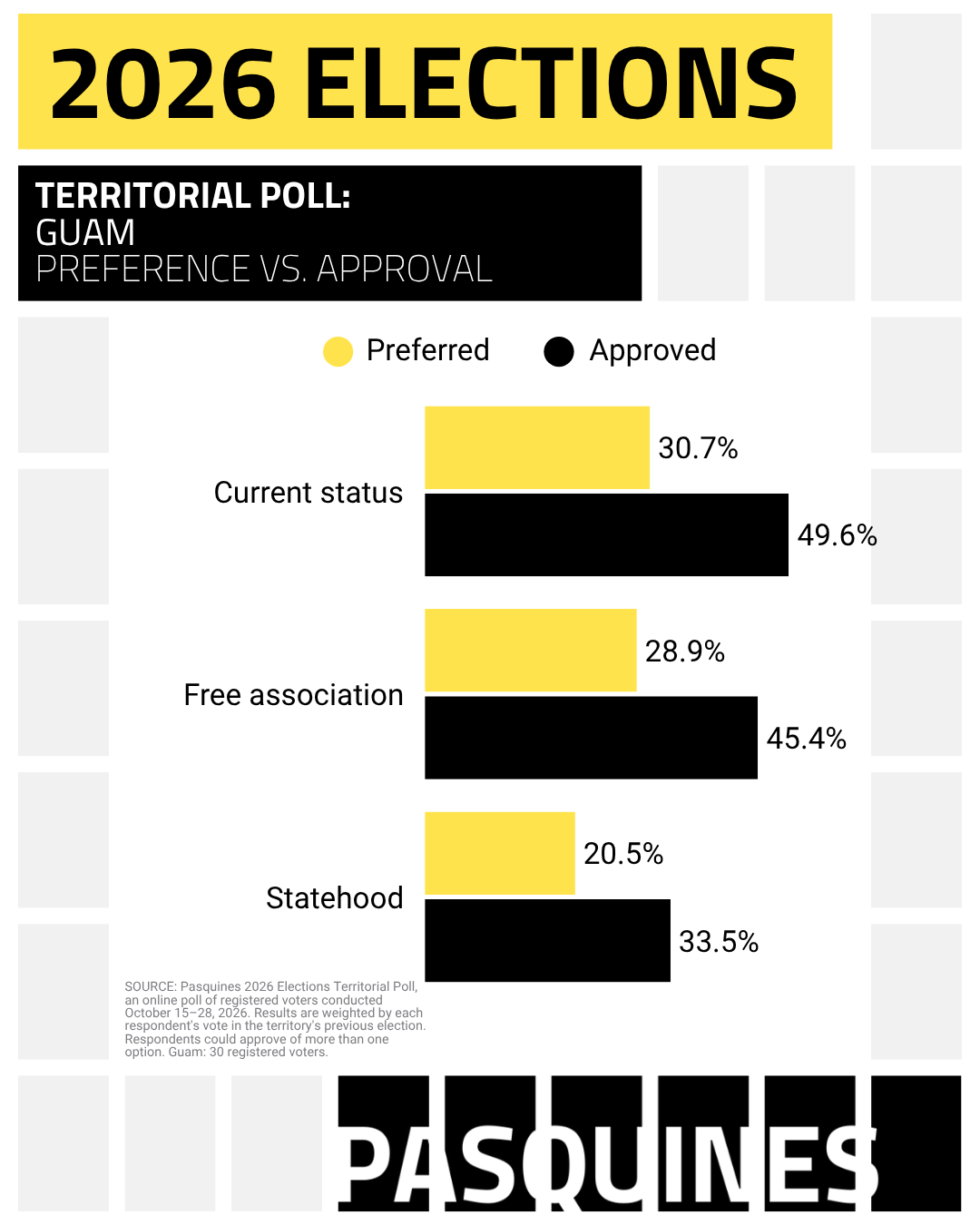
Guam was the most divided territory. The current status (30.7%) narrowly led independence with a free association pact (28.9%), and when respondents could approve of more than one option, free association (45.4%) nearly matched the current status (49.6%). Guam’s Commission on Decolonization describes free association as “a relationship between two sovereign nations,” under which Guam could negotiate a compact with the United States, as Palau, the Marshall Islands, and the Federated States of Micronesia have. Guam’s own attempt to choose was halted when federal courts struck down its planned self-determination plebiscite because the law limited the vote to “Native Inhabitants of Guam.” At the UN in October, the United States disagreed with criticism of that ruling and reaffirmed what it called its “sovereign right to conduct military activities in accordance with its national security interests.”
In Puerto Rico, a majority for change
Puerto Rico is the one territory where a majority favored a change, and it has voted for one before. Voters there chose statehood in referenda in 2012, 2017, 2020, and 2024, but admission requires an act of Congress. In November 2025, President Donald Trump (R) and US House Speaker Mike Johnson (R) called statehood “highly destructive” and “very damaging” to the United States. In the poll, 61.9% of Puerto Rico respondents approved of statehood, and 36.3% approved of the current status.
The status has also been tested in court. In 2022, the US Supreme Court ruled 8–1 in United States v. Vaello Madero that the Constitution does not require Congress to extend SSI to residents of Puerto Rico. It found that their exemption from most federal income, gift, estate, and excise taxes supplied a rational basis for treating them differently from residents of the states. Justice Neil Gorsuch, concurring, wrote: “The Insular Cases have no foundation in the Constitution and rest instead on racial stereotypes.”
Puerto Rico’s finances are also overseen by the Financial Oversight and Management Board, created under the federal Puerto Rico Oversight, Management and Economic Stability Act (PROMESA) of 2016. The board has told the government not to implement a 2024 municipal tax law unless it confirms the law complies with PROMESA and the certified fiscal plans. In the poll, 72.1% of Puerto Rico respondents viewed the board unfavorably.
For all five territories, the next count is being drawn up without them. The United States Census Bureau’s proposed rules for the 2030 census, which closed for public comment on November 2, are built around apportioning US House seats among the states and do not mention Puerto Rico or any other territory. The proposal says the bureau plans to consult tribes but says nothing about consulting territorial governments, Pasquines reported.
About the poll
The poll was open online from October 15 to October 28, 2026. Respondents came from Pasquines’ opt-in online panel, not a random sample. Each response was weighted by the respondent’s reported vote in their territory’s last general election. Because the samples for American Samoa and the US Virgin Islands are small, their results should be read as indicative only.
Polls open on November 3, 2026, at these times, with results expected soon after they close:
- Guam: 7 am to 8 pm ChST (4 pm November 2 to 5 am November 3 EST)
- Northern Mariana Islands: 7 am to 7 pm ChST (4 pm November 2 to 4 am November 3 EST)
- US Virgin Islands: 7 am to 7 pm AST (6 am to 6 pm EST)
- American Samoa: 6 am to 6 pm SST (noon to midnight EST)


0 Comments